Gotta Go Lean Blog

Workgroup

“Workgroup” is a generic term used to describe an organization within a company that reports to a single individual. A workgroup may be a small team reporting to a lead, or a much larger group reporting to a department manager. In many traditional companies, workers are organized by function. In a fabrication area, for example, there may be a weld team, a group that runs the presses, and a CNC team. From management perspective, this Read more…

Solutions

Solutions in a Lean environment tend to be temporary. The rationale behind the statement lies within the term “continuous improvement”. Any new process you develop, by definition, will eventually change. “Solution” implies that a problem is solved once and for all. The two terms don’t play nice together. I don’t recommend that you become a stickler and ban the use of the term “solution” within your continuous improvement culture. I do, however, advocate that you Read more…

Resources

There is a common misconception that Lean is free. The truth is that making improvements requires a variety of resources. That’s not to say you have to spend a lot of money to make changes, but every project does require an investment. In fact, that is one of the big challenges of Lean in particular and, to be honest, management in general. There is a finite amount of resources available and a practically limitless way Read more…

Responsibility

Responsibility is the state of being accountable for something. It may be a team, a process, or an entire company. In general, responsibility is the cost of leadership. Being in charge means that a person has to make sure that things go as planned. Responsibility means having to answer for one’s decisions. Authority is closely tied to responsibility. If a person is going to be in charge of something, they will also need the ability Read more…

Walk Time

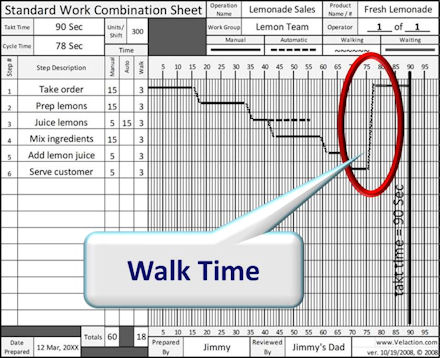
Walk time is an important factor in continuous improvement. Its main impact is on the seven wastes and on Standard Work. Obviously, the problem is that walking takes time that could be better spent working on a process. Walking distance adds up in a surprising hurry. For example, if a person walks just 50 feet during a process, he or she does 30 times a day, it adds up to 1,500 feet per day, or Read more…

Projects

A project is a set of interconnected tasks intended to achieve a specific goal. It is characterized by having a fixed end. Projects can be either individual or collaborative in nature. They are often limited by some constraint, usually cost. The practice of running a project is known as project management. Different versions of project management methods exist, but they generally break a project into 5 phases. They tend to loosely follow this breakdown: Initiation Read more…

Workstation Design

One of the key elements of any process is the workstation. Simply put, a workstation is the area that contains the work surfaces, fixtures, tools, and materials needed to perform a job. Classic thinking promotes the use of standard workstations. These off-the-shelf setups can be interchangeable, and often can be purchased at significant bulk discounts. The problem with purchasing a workstation out of a catalog is that it does not necessarily meet the needs of Read more…

MYLS Newsletter: June, 2013

As I write this, I am facing a bit of a dilemma. I have seen a few red flags popping up in the Lean community, and wanted to address them. But on the flip side, I don’t want to come across as being all reprimandy, especially since what I am seeing is coming from just a few interspersed people. I am afraid, though, that some of the things I have observed will become contagious and spread. So, what I will do instead is just post a few rules that I’d like you to help me enforce. If you see these things going on, please make a point of addressing them.

8 Wastes / 8th Waste

The 8 wastes are a variation on the seven wastes that were first proposed by Taiichi Ohno, the father of modern Lean. The original seven wastes are: Transportation Inventory (Excessive) Motion Waiting Overprocessing Overproduction Defects (Note that the first letter of each of these wastes spells the acronym “TIMWOOD“.) The one element that is notably missing from this list is the human factor. For that reason, many people add an eighth waste to the original Read more…

How do I “sell” Lean to my team?

How do I “sell” Lean to my team? Like it or not, the early stage of any Lean transformation contains a sales pitch to the team. The members of the organization are being asked to take on something new. For them to fully commit, to fully buy in, they need to see the value of the path they are being asked to take. The truth is that changing to a Lean organization is a long journey, Read more…

POLL: How long will it take a typical company to become “Lean”?

POLL QUESTION: How long will it take a typical average company to become Lean?

One of the questions that many people have when they start a Lean journey is, “How long will it take?” Now, the truth is, this question is nearly impossible to answer. The motivation and resources of the company, the quality of the leadership, the presence of a crisis, and a host of other factors affect the speed with which a company embraces change…