| 🔍 > Lean Terms Directory |
7 Wastes
The 7 wastes is one of the most important continuous improvement terms you will hear. Most of the Lean tools, at their core, focus on reducing waste to improve flow.
The seven wastes provide a systematic way to categorize problems and identify improvement priorities. When assessing a process, looking for the 7 wastes helps Lean teams find more opportunities to streamline the flow of work.
The 7 Wastes are:
- Defects
- Overprocessing
- Transportation
- Motion
- Waiting
- Excess Inventory
- Overproduction
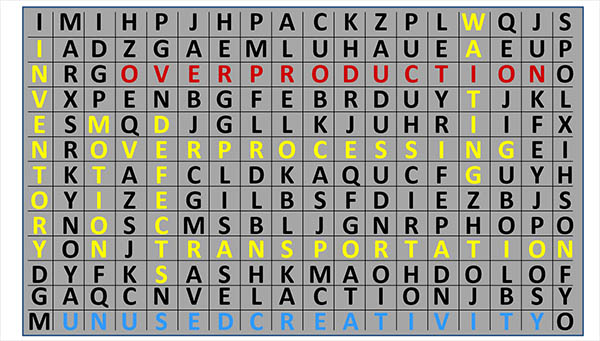
Identifying Waste is a Teachable Skill
Taiichi Ohno (considered by many to be the father of Lean) highlighted overproduction as the worst of all the 7 wastes.
Occasionally, an extra waste will be added to the original seven wastes. This 8th waste is “unused creativity.”
Try not to get too wrapped up on deciding which form of waste something is—waste elimination, or at least waste reduction, is the goal. It doesn’t really matter which category you assign it to. If something is waste, eliminate as much of it as possible.
In a Lean culture, waste is usually defined as anything that doesn’t add value. Note that the term ‘waste’ is often used interchangeably with the Japanese word, muda, but more accurately, muda means ‘wasteful activity’. It is closely related to the terms mura (variation or inconsistency) and muri (unreasonableness or overexertion).


Taiichi Ohno identified seven types of waste.
The 7 Wastes are…
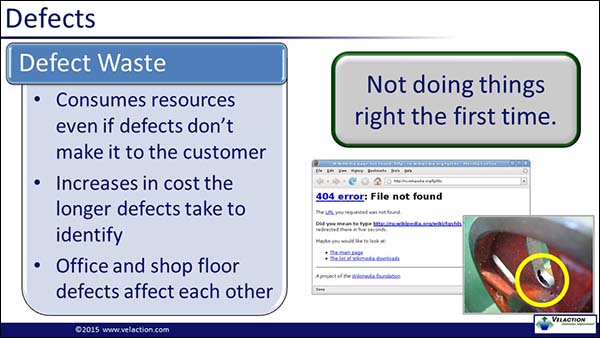
- Defects. Defects in products—when items don’t work properly—are clearly a waste. But defects can also happen in processes, such as building the wrong model or delivering a part to the wrong location. Defects obviously require work to correct. Worse, if they make their way downstream to a customer, the poor quality can reduce profit in the form of lost sales. Defects give otherwise loyal customers a reason to look elsewhere for a more reliable product. Where can defects be traced back to?
Every defect is caused by an error in a process.
The obvious solution then, is to find where the errors occur and fix the process. Defects for a roadside lemonade stand include the obvious—spoiled lemons or bugs in the lemonade, but spilled drinks, sticky cups, or incorrect change are all types of defects as well.
- Overprocessing. This is generally viewed as anything in excess—any unnecessary steps or processes that do not add value to the end product or service. A young neighborhood boy selling lemonade would be overprocessing if he shook up his lemonade in a sealed container and then stirred it as well.
- Transportation. Moving material from one place to another wastes time and energy and includes a risk of loss or damage. At first glance, transportation may seem necessary; but it is normally the result of a non-Lean layout. Sometimes, this type of waste is so bad that when a particular route is traced on top of a factory map, it looks like a bowl of tangled spaghetti. This type of waste can be present in a Lean office as well. Perhaps you have to carry a file down a hall to a fax machine and then walk it back to a file storage room. Jimmy might have had this form of waste if he frequently carried lemons, water, or cups back and forth between the house and his stand.
- Motion. While moving material or products from one location to another is transportation waste, the unnecessary movements of workers or tools is a waste of motion. Wasted motion takes time and uses up energy, especially if the tool or equipment is heavy. Other examples include the following:
- Re-orienting parts to get them into a new position.
- Walking between workstations to get tools.
- Shuffling files to get to the right one.
- Flipping a tool around in your hand to get it ready to use.
If Jimmy took phone orders and had to walk into the house each time the phone rang, that would be an example of wasted motion.
- Waiting. Waiting for parts, letting glue set, watching a machine work, staring at the hourglass on a computer screen—all this is waste. Jimmy would be wasting time (waiting) if he stood by watching his juicer squeeze lemons.
- Inventory. An excess of inventory ties up money that could be used for other things. It also slows down the speed of production, which matters most when custom products or perishables are involved. It is important to remember that inventory includes not only supplies of raw materials but also finished products awaiting sale. Jimmy has inventory waste when his stockpile of lemons and sugar exceeds his immediate needs.
- Overproduction. Overproduction occurs any time an upstream process produces more than a downstream process can use right away. The result is always the same: Inventory piles up along the value stream. Overproducers generally have a reason for making more than needed. Workstations might be far apart, and big batches reduce total travel time because fewer trips are needed. Maybe the overproduction is a hedge against maintenance problems. Perhaps machines take a long time to switch between parts (excessive setup time), so the operators run large lots. Regardless of the reasons (most of which are avoidable), overproduction is wasteful. Slicing lemons faster than they can be juiced is an example of overproduction in Jimmy’s roadside operation.
- The 8th Waste. You might also see an eighth waste added to the original seven. It is normally called something like the “underutilization of people” or “unused creativity.” In a nutshell, it deals with the waste of human potential. People in every organization have great ideas inside of them. Leaving those ideas untapped certainly sounds like waste.
More About Overproduction
Many people have the misconception that overproduction does not exist outside of the manufacturing sector. Lean office waste (and service waste) certainly looks different than it does in manufacturing, but it is present, nonetheless. It is primarily apparent when work is pushed onto the next step and hits a bottleneck, where it will sit for a long period before being touched again.
When work gets passed on without any regard for how backed up the next worker is, the system soon gets swamped and bogs down. For example, an overworked engineer may routinely have design change requests piled into a stuffed inbox.
What’s the result? Being backed up adds work—prospecting to find the right document, trying to prioritize, and answering the inevitable calls of, “Where’s my stuff?” Notice that these things are actually other forms of waste.
That is because:
Overproduction creates or hides all the other six types of waste. For that reason, it is widely considered to be the worst of the 7 Wastes.
You can also think of excess capacity as overproduction in service environments. For instance, when a plane takes off, the airline is paying to move all the seats, whether they are empty or full.


Words of Warning About the 7 Wastes
- Don’t spend more than a few seconds trying to categorize waste. The key is to identify it.
- Don’t spend time identifying waste if you aren’t going to work to eliminate it. That just adds to the waste.
- Don’t tolerate waste. It is easy to become numb to it. The more visual you make a process, the more waste stands out.

Learn to think in terms of the 7 wastes. When you find yourself doing something extra, think overprocessing. When you are carrying a part, think transportation waste. When you walk around a pile, think inventory waste.
When you call things what they are, you will keep the problems front and center, and will be more likely to do something about them.
Also, keep in mind that in a Lean culture, it is everybody’s job to go after the 7 wastes. It isn’t enough to just identify the problems. You’ll also have to use the PDCA cycle to continually eliminate them. If you are not familiar with improvement methodologies, ask your boss for assistance, but keep in mind that waste generally is closely linked to the frustrating parts of your job. As you start learning to identify and eliminate the seven wastes, you’ll find that your job satisfaction will start to rise.

One of the biggest misconceptions about Lean is that it focuses on waste reduction. The truth is that waste reduction is a means to an end, and that end is creating flow.
Flow lets you serve customers faster, and with better quality. It keeps your company flexible, as there is no inventory and oversized infrastructure to keep you from responding to changing market conditions.
The Objective of Waste Reduction
If waste reduction was the only objective, then the business would have a profit threshold. It could only make as much as sales currently brings, and that would be with a 100% profit margin. Lean’s real power is in pulling out the waste the holds back growth.
To get the streamlined flow that drives growth, though, your job requires being relentless at attacking the seven wastes. When things start working smoothly, stress the system by reducing inventory. Pull people out of the process. Take away some floor space. Doing those things will remove all the cushion that is built into a process and will highlight inefficiencies.
As you free up resources and speed up the throughput and flexibility of your operation, you will open up the opportunity for growth.
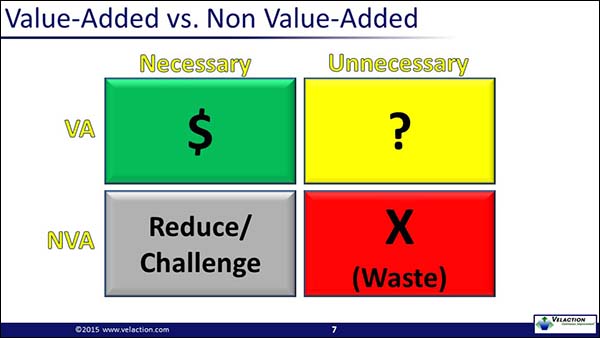
Waste and Value are Closely Related

Key Points for the 7 Wastes
- The 7 Wastes are a great way to make waste identification a systematic process.
- Categorizing waste into the seven forms makes you more likely to identify a greater number of problems.
- Identifying waste is only part of the battle. You still have to eliminate it.

The waste recording form is a great tool that you can use to identify and eliminate the seven forms of waste. This helps you start thinking about how to go about eliminating that waste.
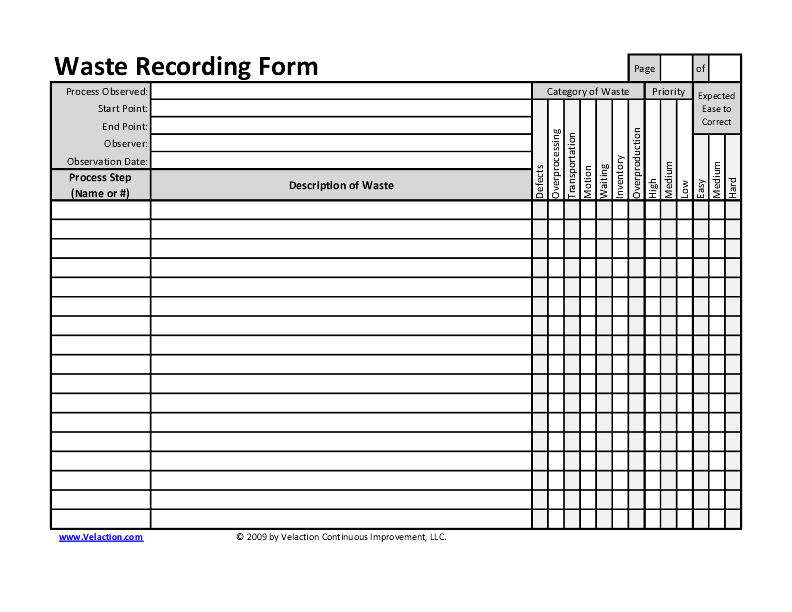

Download a waste recording form and observe a process. Work as a team to get more sets of eyes on a process and use the discussion to help identify even more waste. Talking about the problems often triggers additional ideas.
Use the list of waste as the basis for an improvement plan. Go after the biggest problems that seem to have the best chance for resolution first.
1 Comment
Jerome Reynolds · June 3, 2010 at 9:06 am
Thank you! I will try out the forms