| 🔍 > Lean Terms Directory |
Problem Solving
To understand problem solving, one must first have a clear definition of what a problem actually is. A problem is simply a gap between an expectation and reality. The most common way people look at this relationship is that they focus on a change in performance, meaning that the reality side of the equation shifts. For example, consider a process that used to be capable of meeting a quality standard. If something changes, the output may start to fall below the target.
The less common way of looking at the relationship between targets and reality is that the expectation side of the equation may be the one undergoing a change. This is commonly the case when an aggressive improvement target is set to capitalize on an opportunity, or a competitor makes a performance breakthrough and the company has to play catch up.
With that definition, then, problem solving is simply the process for closing the gap between what should be and what is. Regardless of how the gap formed, though, the methods used to close it are very similar.
Problem Solving Structure
Most people tend to approach problems informally, or without any structured approach at all. There are, however, several formal methodologies of problem solving that include:
- The Scientific Method
- TRIZ
- DMAIC
- 8D (8 Disciplines)
- PDCA (Plan-Do-Check-Act)
- The Kaizen Event Process
While each of these approaches has its own specific sequences of activities and situations where they are most effective, they all share several common activities. In each method, you must clearly articulate what the problem is, identify the underlying causes of problems, select appropriate solution(s), and implement a lasting fix.

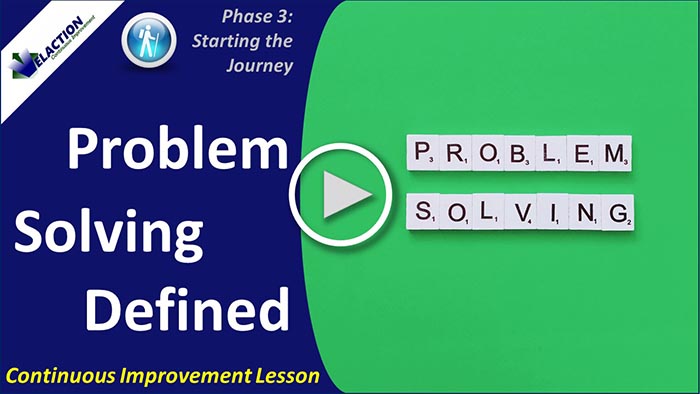

On the surface, the problem-solving definition sounds simple. Just close the gap between reality and the way things should be. The problem is that you might not know what the ideal state is. Or, you might not understand how you are currently performing. There are no road signs that tell you where you should be going or where you are. If you get either one of those wrong, you’ll never have a chance to solve a problem.
That is why following the steps of a structured problem-solving process is critical to getting the answers you need to narrow that problem chasm.
Problems and Processes
Problem solving falls along a spectrum. It might be addressing a very basic issue, like deciding where to go out for dinner. Perhaps you expect to have a destination chosen when you get into the car, but the current reality is that you have no restaurant in mind. Problem solving may also address a more complicated challenge such as figuring out how to land a rocket on the moon.
Problem solving gets much less daunting, though, when you realize that all problems are related to a process, or set of processes, at their source. If your find and fix that process, the problem goes away. On occasion, you may even find an easy fix related to this situation. Sometimes an effective process exists, but is not, for some reason, followed. Figure out why it is not being followed, and you can match reality to your expectation with relatively little effort.
The Zen of Problem Solving
While problem solving is a process and should be rife with facts and data, there is a sort of “Zen” to it. While the actual methodology is rooted in hard science, there is a tremendous amount of “art” to the creative application of the tool.
- You never really solve a problem. You just come up with a better current way of doing things. You need to understand that expectations have a way of shifting.
- Problem solving is relative. “Best” solutions depend on the goals that success is measured against. What does this mean? For example, whether you emphasize cost or quality more will affect how you go about closing the gap.
- Problem solving is part science, part art, part experience, and part luck. That said, the more structure you use, the less you have to rely on chance. You also can eliminate the amount of art and experience that is required by using processes to support your problem solving.
- Don’t confuse problem solving with symptom solving. You can do a lot of work to solve a symptom, but the problem will simply pop out sideways if you don’t eliminate the root cause.
- You will fail often. If you only focus on simple problems, you’ll have a pretty good success rate, but you’ll have a pretty average company. The more challenging the problems you attack, the more times you will come up with insufficient solutions. The goal is to learn from each failure and get better. You’ll also find that a lower success rate against more important issues is better than a high success rate on those that matter little. This point is very important but is one of the more difficult mindsets to overcome. People have been conditioned to think that failing is always bad and should be avoided at all costs. Leaving one’s comfort zone, however, is where real progress is made, but it is also where the risk is. There is an anecdote about Thomas Edison. He failed on countless attempts at making the light bulb before realizing success. When asked about it by a reporter, he shot back that he knew a thousand ways not to make a light bulb and asked the reporter what he
- Solve the right problem. Often, efforts to improve precede actually understanding what the need is. If you don’t truly know what is going wrong, you’ll never achieve success.
The Need for a Problem-Solving Methodology
Why is there a need for a systematic approach to problem solving? Simply put, people are not wired for the task of well-thought out problem solving. Why?
- We make emotional decisions.
- We latch onto things that we are familiar with.
- Our minds fill in the blanks. We make up information to close the gaps in what we see. Look at this picture and decide what it is you are looking at.
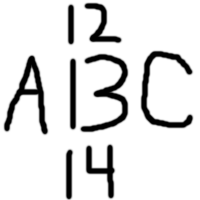
What is this? (Click image to see the answer)
- We give additional weight to evidence that supports our theories.
- We won’t let go of beliefs, even when there is contradictory information.
- We are biased based on our skills and background.
This wiring helps us when we need immediate responses. It developed when we needed to quickly identify and evade sabre-tooth tigers. Figuring out how to eliminate lost files or dings in car doors doesn’t have the same instant response requirement.
So, we overcome this wiring by using a structured approach to problem solving. There are many benefits to not simply “winging it”.
- The structure prevents us from missing steps.
- Structure is easy to communicate, which supports teamwork.
- Other people have more confidence in solutions that come from structured methods.
- Perhaps most importantly, a structured approach can compensate for how human nature hampers problem solving.
Note: The symbol shown earlier in this section could fit between A and C, or 12 and 14, depending on what you believed you saw.
Complexity and Risk vs. Structure
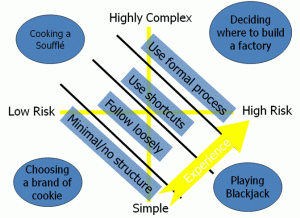
The more complex a problem, the more a structured method will help you. Risky problems are also good candidates for structure.
Note that experience can offset the need for some structure, but it increases risk anytime you skip a step. With experience, you can shift the bands in the matrix image in the direction of the yellow arrow. Be careful, though. It is a shortcut. While it saves resources, the best you can do is come up with a solution that matches the one you would have gotten from the full process. It is far more likely, though, that you will come up with a worse solution than you could have by using the full methodology.
Selecting a Methodology
As mentioned in the overview, there are many different formal approaches to problem solving. Practice using the different methodologies and find one that you like. Liking something makes you more likely to use it. You may also find that you like particular methods in specific situations. Don’t feel like you have to limit yourself.
Problem Solving and Continuous Improvement
In continuous improvement, you will find uses for problem solving at every corner. Each time you assess your progress towards your goals, you unearth a great source of problems to solve. Also, any metric that is behind presents a chance to solve a problem. Missed targets are, in fact, one of the best sources of problem-solving opportunities. Done right, they represent a direct link back up to your strategy, and thus presumably give you the best bang for the buck when allocating limited continuous improvement resources.
Another great problem-solving opportunity occurs when a process that was in control suddenly has problems. These may not be things that are measured towards your goals, since they were presumed to be working. An example is if you have historically had great customer support, and it suddenly slips.
Learning Problem Solving
I can’t stress this enough: practice, practice, practice. Get so that the problem-solving methodology you choose is second nature, and you can do it automatically. If you get to that point, you will dramatically reduce wasted effort in fixing problems.


Warnings About Problem Solving:
- Don’t try to solve problems without a structured approach. You’ll miss steps and won’t have a good way to communicate with others.
- Learning on your own is possible, but inefficient. Find a mentor with significant problem-solving experience to guide you.

There are few things that a frontline employee can learn that will have a bigger impact than effective problem-solving techniques. In virtually any job, a team member will encounter a relentless onslaught of issues and opportunities that require closing the expectation gap.
In addition to enabling an employee to make his or her job better and easier, problem-solving skills make him stand apart from his peers. When bosses look for employees to promote or give choice assignments to, they evaluate not only performance but also potential. They want people who can deal with the variety of obstacles that will be thrown in their way as they are given greater responsibilities. Proving yourself to be an effective problem solver in your current job gives your boss confidence that you can handle the greater challenges that will come with new roles.

As a leader you are responsible for developing the problem-solving skills of your team members. For many of the jobs of the people you lead, it is not important to have the same skills your team members possess. For example, if you lead a manufacturing group, you probably don’t need to have welding skills, and you probably will not have a detailed understanding of programming a CNC machine. If you manage an IT group, you may not have the technical skills to do every job that you supervise.
Problem solving, however, is a different animal. It’s virtually impossible to mentor a team member without having significant problem-solving skills of your own. To this end, you must first become an expert problem solver in your own right.
There are really three basic things you must do to become an expert:
- Get trained. Obviously, you must have the knowledge that you wish to impart upon others.
- Practice, practice, practice. You won’t become great at problem-solving unless you do it consistently. And that doesn’t just mean winging it. You must use a formal process. A good way to gain experience is to use a structured method even for problems that seem simple. It will reinforce the use of the tools, especially if you end up with better results than you anticipated.
- Find a mentor. While you can learn on your own, you’ll get expertise at a much faster pace if you have a mentor looking over your shoulder. If you can’t find a readily accessible coach, at least find a peer who can review your work. The key is to develop a feedback channel so you can identify your weaknesses and improve them.

Next Steps Towards Problem Solving:
- Problem solving is a process. Don’t wing it.
- Problem solving is a learned skill. Spend time refining your abilities.
- A problem is the gap between an expectation and a current condition. Problem solving is the approach used to close that gap.
0 Comments