Jidoka
The most common definition of jidoka is “autonomation”. It is Japanese in origin, as are many specialized words in Lean. The term traces its roots back to the early 1900’s at Toyota in Japan, then a textile manufacturing company. Sakichi Toyoda, an inventor and the founder of Toyota, developed a device that could detect broken threads in a loom and stop the machine from producing defective material. This concept, in which intelligence was added to machines, enabled companies to greatly increase the number of machines a single operator could run—with very little extra effort on the worker’s part! With jidoka, production becomes much easier for operators and much more profitable for companies.
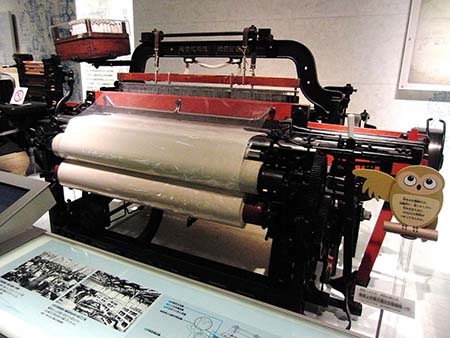
The definition of jidoka mentioned above, autonomation, is essentially automation with a human touch. But it has also come to mean more than that. It is about stopping whenever an abnormal condition is detected, fixing the defect, and then countermeasuring to prevent further occurrences. Many jidoka devices are combined with an andon light, or signaling device, to alert the operator of the abnormal condition. The purpose of autonomation is to separate people from machines, so an operator can do other tasks while the machine is running.
Companies often emulate Toyota and depict their production system as a “Lean house”. As a testament to its importance and prominence in Lean companies, Jidoka is frequently depicted as one of its pillars. The other common pillar, JIT or just-in time manufacturing, and jidoka work together to create manufacturing excellence.
NOTE: Image of Toyoda Automated Loom is shared courtesy of Wikimedia Commons.


Many automated machines today have jidoka built in. They stop when something goes wrong—a bit breaks, for example. Most of us even have a good example of this in our homes. Washing machines shut themselves off if they get out of balance or if the lid is opened.
Manual processes have much less of this built in. People often have a hard time detecting an abnormality. Imagine if you had to stay near your washing machine to listen for the signs of imbalance. You’d be extremely limited in what you could do, and your time would be wasted.
Jidoka reduces the need to be near a machine continuously.
The Basic Steps of Jidoka
- The machine detects the abnormal condition.
- The machine stops itself.
- Implement a stopgap.
- Resume production.
- Identify the root cause.
- Quickly implement a permanent fix.
The steps of jidoka require more than just detecting abnormal conditions and stopping production, though. It also needs you to implement both a stopgap to get production moving again and a permanent solution to prevent future occurrences.
Taiichi Ohno is credited with the following quote regarding these requirements:
“No problem discovered when stopping the line should wait longer than tomorrow morning to be fixed.”
Simply put, every problem you identify is an opportunity to improve. Don’t squander those opportunities through inactivity.

Jidoka Risks During Implementation
- Jidoka is the less emphasized of the two pillars of the Lean House. Most people can recognize the immediate benefit of improving flow and reducing inventory. Jidoka requires a much larger mental shift in the way companies operate because it gives power to frontline employees to both stop production and to implement solutions.
- Some Lean practitioners are fairly liberal in how they define jidoka. Most interpretations focus on abnormal conditions. A few practitioners even consider automatically shutting off when production is done as a form of autonomation. Others might overlap the response process regardless of whether a machine or human identifies a problem. While it can be a bit confusing, don’t spend too much energy on the issue. Just make sure that the definition within your company is clear.

Why is Jidoka Hard?
The real challenge to jidoka is not in finding a problem or even stopping a machine. It is in what happens next. An all too common response is that a well-designed machine stops when a problem occurs, but the operator simply clears the issue and restarts the machine. It is surprising how often I have heard something similar to, “That happens all the time” when I watch a machine stop for a problem.
The key to success in continuous improvement is this:
Quickly and relentlessly fix the problems you discover.
I’ll say it again. Fix the problems you discover, now. Far too often leaders focus on the big gains and devote their continuous improvement efforts to big projects when there are many, many small issues that need fixing.
This fix generally comes in two steps. The first is the stopgap. You will need to implement an inspection step or a test station immediately to prevent defects from escaping. You won’t always be able to solve the problem immediately, but you can get the line back up and running after a problem is discovered.
The second step is the more refined problem solving approach. This entails root cause analysis to determine the exact origin of the problem and implementing a permanent solution to prevent any future recurrence. This step requires discipline. You have to instill the attitude that it is not OK to allow a problem to recur.
It is your responsibility to provide the resources to make the fixes, though. You can’t expect teams to fix problems if they are unable to break away from production work when necessary. In addition to resources, you also have to make sure your team has the skills to do the things you are asking of them.



10 Comments
JRK · May 2, 2012 at 8:11 pm
Hi, Jeff
This site is a treasure for Lean Practitioner. Great!
The list of LEAN Tools clearly shows the connection between LEAN & TOC. Every waste is because of process problems and creates a constraint. Everybody now subordinates to elimination of this waste and flow improves leading us to our goal of “Making Money Now & In Future”.
Lean Manufacturing Techniques · January 10, 2011 at 9:12 pm
The implementation of smooth flow exposes quality problems that already existed, and thus waste reduction naturally happens as a consequence. The advantage claimed for this approach is that it naturally takes a system-wide perspective, whereas a waste focus sometimes wrongly assumes this perspective…Thanks
Jeff Hajek · January 10, 2011 at 11:04 pm
I don’t think you can improve flow without a redcution in waste. Flow is the result of a focus on reducing waste, not the cause.
I do agree that a systemic look at flow can show you the best areas of waste to focus on first, but it is still waste reduction that creates flow.
Sanjeev Goel · August 27, 2010 at 12:02 am
Simple definition of JIDOKA is
“Make Problem Visible”
Jeff Hajek · August 27, 2010 at 7:08 am
Sanjeev,
Thanks for your comment. I should have stressed the importance of the visual control aspect of jidoka more.
But I think that is only the first part of jidoka. It also has the very important aspect of stopping a process when there is a problem. It is more than just a warning light.
Regards,
Jeff
Sanjeev Goel · August 27, 2010 at 11:38 pm
Hi Jeff,
Thanks for correcting me, this Valaction.com is a treasure for me. Only yesterday I have found it. Great!
Regards
Sanjeev Goel
Jeff Hajek · August 29, 2010 at 5:38 pm
Sanjeev,
Very kind words, and thanks for your input as well. My terms get better when my readers contribute.
Thanks again.
Jeff
mahmoud badr · January 20, 2010 at 11:51 am
whenever i check my e mails i found a new hint about lean , a nice snack easy to digest , very informative , many thanks to you .
Lean Consultancy · January 17, 2010 at 8:44 pm
We do like the concept of jidoka and we think also that in Lean Manufacturing is important reducing inefficiency and waste. However to achieve success with a lean process it requires reliable equipment, and this can only be achieved by addressing your maintenance.
Ramon Oropeza · December 1, 2009 at 1:37 pm
Hi
I have intersted abot jidoka method a jidoka implementation
We need a Training abaut it,
But we have a problem, we need te trainning in spanish because we want to involve the production people
If you have a consulting to speake spanish, please contact me, and give me information.
tks a lot
Comments are closed.