| 🔍 > Lean Terms Directory |
Kaizen Event
A kaizen event is a discrete continuous improvement project with a defined start and end point, usually done in a single week.
A typical kaizen event consists of a day of training, a day of process walking and analyzing the information gathered, followed by two days of improvement activity. The final morning (Friday) is used for wrap-up, training on the new process, and preparing a report out, which is usually presented late morning or early afternoon.
A kaizen event is attended by an ad hoc team that is gathered for the duration of the project.
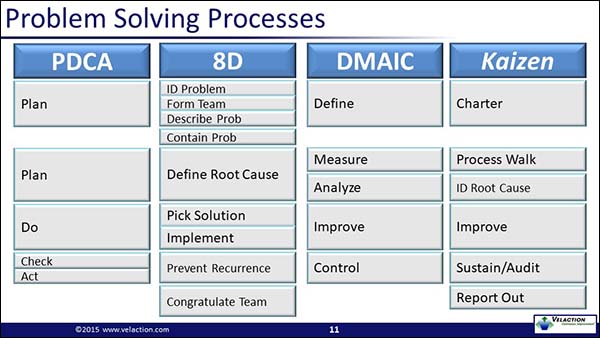
Kaizen is not the only improvement tool
The goals tend to be aggressive, but tightly focused on a specific work area or process.
Kaizen events are most effective when they are part of an overall improvement strategy. That means they are tied to policy deployment, daily management, or KPIs.
Download our Kaizen Forms and Tools


A kaizen event is one of many tools in a Lean toolkit, though it is often, mistakenly, overemphasized in its importance. Typically an organization that is new to Lean tends to limit its continuous improvement activity to kaizen events. Not surprisingly then, frontline employees associate Lean primarily with kaizen events. As an organization matures, it begins to focus more on daily improvement activity, and uses kaizen events more strategically.
A kaizen event is best suited for projects in which a production area needs an overhaul, or where the solution is not known. Some problems are simple and can be figure out with individual effort. More complicated problems often require collective brainpower. The structured, team-based problem-solving effort that a kaizen event offers can overcome the toughest of problems.
Kaizen events are also especially helpful when there is a need for dramatic results quickly. If a new product line is being rolled out in a month, a kaizen event on an existing line to reduce the footprint by 50% might be just the answer.
Remember that not every problem needs a kaizen to solve it. You have other tools in your kit.
Kaizen Event Expectations
The results of a well-led, well-coached, well-selected, well-staffed kaizen event can be dramatic. 90% reductions, whether in floorspace, cycle time, lead time, or inventory are not unheard of, though typical gains tend to be somewhat lower. 20-50% improvements are more typical.
Events serve two primary purposes. One is to get results, and the other is to train team members. Both occur in every event, but the way the team and goals are structured, and the time leaders commit to mentoring both affect where the needle lands on the scale. For critical projects, stack the team with experienced ringers. For learning-focused events, match up people new to kaizen with a handful of experts to encourage coaching. Set expectations accordingly.
Reporting Kaizen Results
Reporting the results of a kaizen event is tricky. Most teams self-report, and often include projected results in their tally. That leads to inflation. Some results are indisputable, though. If the floorspace is freed up and something else moves in, it is a real gain. If cycle time is reduced and a person is freed up to work somewhere else, it is a real gain. If production doubles without adding people, it is a real gain. If injuries drop significantly, it is a real gain.
Timeline of a Kaizen Event
The basic flow of a kaizen event covers about 6 weeks. This includes the planning, the event week, and follow-up. (Get our full kaizen event calendar.)
- 4+ Weeks Prior: The area of focus for the kaizen event is selected and the kaizen charter is completed. (Get our kaizen charter template for free.)
- 1-3 Weeks Prior: Kaizen events require significant planning and preparations, which is most intensive from 1-3 weeks prior to the project. This will include logistics planning, data collection, communication, and potentially, some training.
- 1 Week Prior: For most kaizen events, training is done on the first day of the project, but in some situations, you may see training done the week prior. This is most common for big projects needing the whole week, or if the majority of the team has significant experience. In that case, the prior training is for rookies only.
- Kaizen Event Week, Day 1: Typically, training is done on the first day of the event. As the ratio of newbies to experienced kaizeners changes, the focus on training vs. doing should change accordingly.
- Kaizen Event Week, Day 2: The second day of the kaizen event is normally focused on the process walk, data collection, and root cause analysis.
- Kaizen Event Week, Day 2-4: Upon completion of the root cause analysis, a future state plan is created, and the improvements are implemented. The improvement plan is often recorded on a kaizen newspaper (Get our Kaizen Newspaper).
- Kaizen Event Week, Day 5: Friday morning is reserved for wrap-up and report out prep. The report out is normally done mid-day.
- 1-2(+) Weeks After Kaizen: Kaizen events should have very little follow-up activity, but if there is anything left to be done, it should be completed shortly after the event.
- 30/60/90 Day Audits: Every kaizen event should have an audit plan to make sure the gains stick. (Get our Kaizen Audit Form).
Alternate Names for Kaizen Events
Kaizen events are known by a variety of names. These include:
- Kaizen
- Kaizen Event
- Kaizen Blitz
- Continuous Improvement Workshop (CIW)
- Continuous Improvement Project (CIP)
- Rapid Improvement Workshop (RIW)
- Rapid Improvement Project (RIP)
Key Players on a Kaizen Team
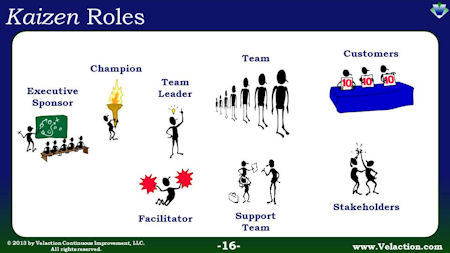
A kaizen will not be successful without the right team.
- Champion: The champion is the person driving the train. It is normally a senior manager or executive who can tear down barriers and light fires.
- Facilitator: Part coach, part trainer, and part leader, this person is typically well-versed in Lean and brings substantial experience to the table. At any given time, a facilitator may be overseeing several kaizen events in different stages.
- Team Leader: The team leader is in charge of the event and does the bulk of the planning and preparation under the watchful eye of the facilitator. The team leader is often the manager, supervisor, or engineer in charge of the process being improved.
- Team Members: Team members are picked from the work area, from the stakeholders, or from the company at large. The best teams combine a variety of experience and skills. Teams typically range from 5-10 people depending on the size of the project.
- Stakeholders: Kaizen events affect a lot of people. Those people are known as stakeholders and should be included in decisions about the project.
- Support Team: Kaizen events often require support that goes beyond what team members can do. This often falls on the facilities team and on IT.

Play a sample…

Kaizen Event Warnings
- Don’t let kaizen events dominate your continuous improvement effort. Daily management and daily improvement are the real powerhouses.
- Take results with a grain of salt. They tend to be exaggerated. Tread carefully, though. You want people to be proud of their accomplishments, so don’t be too restrictive on report outs.
- Don’t shoot for home runs on every event. Some should be framed as learning opportunities to develop a team. It is hard to do that in a pressure cooker.
- Develop in-house facilitation and training expertise. If you have to rely on outsiders for projects, you’ll significantly reduce your pace of improvement.

Kaizen events can be a challenge for you, especially if you are in a role where there is little backup for you. This seldom happens on the shop floor. An assembly line does not pile up work waiting for a person to return. Office workers are not so fortunate. Often, they finish a kaizen event with a massive mountain of work on their desk.
Before agreeing to be on a team, ask about the recovery plan. You may not always have a choice but try to negotiate help in advance. You will get a great deal more out of the project if you are not distracted by the pain your absence will cause you. Keep in mind that this argument carries more weight if you go through the same thing when you go on vacation.
Once you are on the event, try to get the most out of it. Pay attention in training, and take notes. The act of writing reinforces lessons. Also, volunteer to take on tasks. If you are doing things you like, you’ll probably be more focused, and can learn more. Just make sure to get out of your comfort zone so you can add to your skill set.
Also work on developing relationships and contacts. You may not have a lot of opportunities to do this in your normal role. If you intend to advance in your company, knowing people can help. This isn’t to advocate office politics. Rather, you’ll be more effective if you have a network of people you can go to with problems. And you’ll earn a good reputation if you help those people when they come to you for help.

One of the most common mistakes companies make with kaizen events is to treat them like something out of the ordinary. The occasional late nights are fine, but if every kaizen event is a brutal marathon that disrupts home lives, people will soon start viewing them negatively. It will make volunteers hard to find, and the team will be distracted.
When developing a kaizen calendar, try to focus on strategic initiatives. These often come from policy deployment action plans. The majority of the calendar can be filled far in advance but be sure to leave space for the inevitable problems that come up. Find the balance between keeping a steady pace and not overwhelming the organization.
At the beginning of each project you should also decide the tone of the event. Is it going to be a hard-charging, results-oriented affair, or is it going to slow down to focus on mentoring and skill building? Make sure that you have a healthy mix of both. Early on in a Lean journey, you’ll probably be biased towards the learning events, with the mix drifting towards loading teams with experience once more people have a few kaizen events under their belts.

Key Points for Kaizen Events
- Kaizen events are great tools, but not the only one in your Lean toolkit.
- Kaizen events take a tremendous amount of planning to be successful.
- Kaizen events are a team effort.
- Build an internal cadre of facilitators to help keep a steady pace of improvement activity.

Steps to Start Running Kaizen Events
- Find a skilled facilitator to start developing a team of experienced employees. This can be a consultant or a permanent hire. Your choice depends on the size of your company and your commitment to Lean.
- Develop a kaizen event calendar. This prevents you from overloading the company with projects. There is a saturation point where kaizen activity overwhelms an organization.
The actual number depends on the size of your organization. Start with enough events on the calendar for each person to have the opportunity to be on at least one or two event per year. Divide the headcount by 6 (average kaizen team size) and multiply by 1.5 for a decent number of events for the first year. If you have 100 people, it would be 100/6 x 1.5, or 25 events. That would be about one every other week, which is a manageable pace.
The number of events should rise over time, though. For best results, link your kaizen plan with your policy deployment, metrics/KPIS, and daily management.
NOTE: Small businesses will have to be creative in running kaizen events. There aren’t enough people to create focused teams of people away from their jobs. Adapt. Do a few hours of overtime on occasion. Create smaller teams. Bring in some temps. Just whatever you do, don’t let being a small company keep you from improving.
- Plan your first kaizen You can use our kaizen checklist to help keep you from missing important steps.
- Conduct a kaizen Repeat. A lot. (Let us know at info@velaction.com if you need kaizen support.)
- Review your results. This is not just about hitting the goals in the event. It is about reviewing the whole kaizen The better you refine it in your company and the easier a kaizen event is to plan, the more likely people will be to take them on.

We have several forms and tools available to help you run kaizen events.
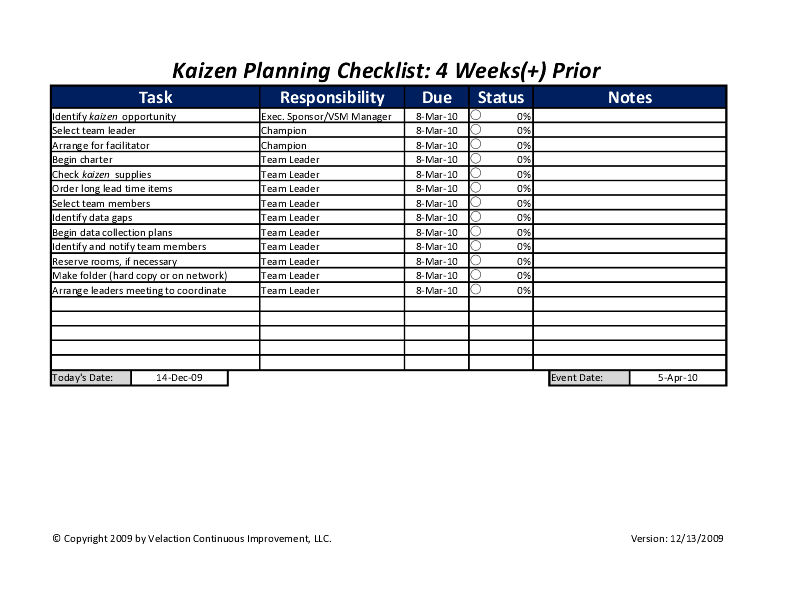
Get this Kaizen Checklist Free
Click the ‘Continue Reading’ button below to answer a poll question about kaizen events.

0 Comments