| 🔍 > Lean Terms Directory |
Job Satisfaction
Job satisfaction is a relatively simple concept. You have expectations about your work. When those expectations are met you are satisfied. When there is a gap between what you expect and the reality of your job, dissatisfaction creeps in.

Job satisfaction plays a critical and often overlooked role in continuous improvement. As a general rule, an employee will do what her boss tells her to do, because it is part of her job. In continuous improvement, the boss needs the employee to do what he doesn’t tell her to do. The employee has to have the motivation and inspiration to act on her own. That doesn’t happen when an employee is dissatisfied.

There’s some good news and some bad news about job satisfaction. The bad news is that a lot of factors influence how you feel about your job. The good news? A lot of factors influence how you feel about your job.
Granted, that sounds contradictory on the surface. The problem is that the world seems to assault job satisfaction from all directions. An economic downturn makes compensation seem too low. Traffic lengthens commutes. Irritating employees get on their coworkers’ nerves. Micromanaging bosses test employees’ patience.
Day to day problems even affect leaders. When employees and customers complain frequently, managers have a tough time. For both employees and their bosses, maintaining job satisfaction presents a never-ending challenge.
So how is this wide range of factors good news as well? Because, with a little creativity, it provides you with limitless options to improve your job satisfaction.
For example, if relationships with coworkers are really important to you, you could recommend a friend for employment. If driving to work is becoming a chore, you might choose to carpool to reduce the stress of the commute and save on gas or move closer to work. If moving up the ladder is your goal, you might decide to pursue some training to earn a promotion and better pay.
Creating a Job Satisfaction Balance
Take a look at this picture of the “Satisfaction Contraption”. Think of job satisfaction like an old-fashioned balance scale. In order for you to be satisfied, the Good Stuff bucket must outweigh the Bad Stuff bucket. Taking charge of your satisfaction is just a matter of adjusting the balance of the scale.
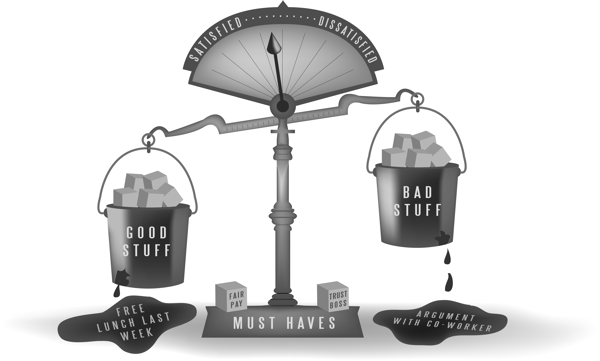
The Satisfaction Contraption from Whaddaya Mean I Gotta Be Lean?
Satisfaction in the workplace doesn’t come from eliminating all the negative things. It comes from making sure that the stuff you want at work outweighs the not-so-great things that happen.
So, how does job satisfaction relate to continuous improvement? I examine this issue in depth in my book Whaddaya Mean I Gotta Be Lean? The basic premise is that continuous improvement requires that employees go above and beyond what is normally expected of them. For that to happen, employers also need to go above and beyond what they normally do to motivate their teams.
Some job satisfaction factors are universal. Employees want a safe working environment and a reasonable system for evaluating performance. Many people want opportunities for advancement. Everyone wants good healthcare and fair pay. (Actually, they want to be overpaid, but will generally settle for fair.)
Since each individual has his or her own personal job requirements, job satisfaction is different for every person. Some people are extremely happy working on an assembly line. They don’t want ambiguity in their lives, and they love the stability in knowing what is going to happen each day. Others get bored with any form of repetition. They need variety in their role to keep them engaged all day long. Employees’ attitudes about continuous improvement also vary. Some people love the opportunity to make changes. Others don’t want that responsibility.
It is imperative to identify low job satisfaction because it tends to translate into poor performance. Dissatisfied employees put in just a little bit less effort, they complain more, and they have higher absenteeism. In extreme cases, dissatisfied people cross the line from not contributing effectively to actually harming the company—perhaps badmouthing products to customers.
Some Factors Affecting Job Satisfaction
- Pay and benefits
- Relationships with bosses and coworkers
- Flexibility and autonomy
- Type of work
- Prestige
- Location factors (commute, proximity to childcare, restaurants in the area, after-work activities, etc.)
- Physical work environment (safety, noise, cleanliness, proper tools, etc.)
- Cultural work environment (trust, positive attitudes, fair policies, etc.)
- Corporate success (job security, opportunities for advancement, etc.)


Although the term “job satisfaction” is frequently used, it is a relatively misunderstood topic. In large part, this lack of understanding comes from three main sources.
First, the jury is still out on a lot of aspects of job satisfaction. For example, the role compensation plays in contentment and how much satisfaction affects productivity are both widely debated. If the experts can’t really agree on the basic premises of job satisfaction, how can frontline leaders?
Secondly, Psychology Today confirms what many people intuitively know. A higher rank in a company correlates to higher satisfaction. That means managers see things through a different lens than the frontline employees do. If bosses and employees have a fundamentally different view on what good and bad is, and how things are going in a company, common ground is hard to find.
Finally, managers don’t have a good idea how their employees feel about their work. In one poll, only 27% of employees said they were satisfied with their jobs. (Hill, 2005) In another survey, managers underestimated the number of employees that said they would soon be looking for another job by about half. (Salary.com 2007)
Here are a few other things to watch out for regarding job satisfaction.
- Job satisfaction is extremely difficult to measure. Even quantifiable methods, such as surveys, depend upon asking the right questions. Surveys are only as good as the questions they ask. If an important factor is left off, the results are incomplete. Good or bad, leaders should confirm the results of surveys with their own eyes.
- It doesn’t take many dissatisfied people to poison an organization. Look at disgruntled players on pro sports teams. When they act out, the team falters.
- Continuous improvement changes the rules on teams. Employees and managers need to address dissatisfaction, so it doesn’t fester. The key is open communication. Managers should be clear about expectations, and frontline employees should make sure that they are letting their managers know what isn’t working and what they need help with.

Job satisfaction is every person’s own responsibility. Granted, it is much easier to make changes when your boss understands how critically important employee satisfaction is, but it is not essential.
Ultimately, you have to balance your own scale if you want to like your job more. It’s not as hard as it sounds. You have lots of ways to adjust your satisfaction. The biggest hurdle is taking ownership of making changes.
Take a realistic assessment of your job satisfaction. List the things you like, the things you don’t like, and the things you’d like to add to your job.
On that list, score each item from 1-5 based on how important it is to you, and from 1-5 based on how easy it would be to improve. Multiple the scores, and rank order the results. That should be the priority of your effort at improving your job satisfaction.

Be enthusiastic about continuous improvement but recognize that many people will not share your zeal. You won’t be able to talk people into being satisfied with Lean. In order to increase effectiveness, you have to actually help your employees get what they want from Lean. That means listening to them and figuring out where they stand and what they need.
As you learn more, evaluate the people on your teams and classify them into three groups.
- Those who are already pleased by continuous improvement (CI) efforts.
- Those who are not pleased now but are receptive to CI; or those whose opinions might be changed.
- Those that are made unhappy by CI and are unlikely to change.
The first group should be encouraged and rewarded. The second group should be cultivated. The third group needs a sit-down. They should understand the behavior that you expect. The conversation should result in a plan. The resistant or hostile employee has to know what she needs to do. You should also walk away with a list of things you need to do to help her transition. Don’t forget the most important item: be clear about what will happen if she doesn’t change her behavior. The hope here is that your assessment about their ability to change is incorrect. This is a case where it would be good to be wrong. If you are not wrong, it means the person won’t change and should not be part of the team. Just be careful about letting one person consume all your time and energy.
Finally, remember that job satisfaction is not one-size-fits-all. You will have to put in a lot of effort to make sure your team is satisfied. It will require knowing what individuals need, tailoring assignments, and modifying your leadership style to help them be successful.
One thing to consider. The reason many managers don’t focus on employee development is not due to a lack of desire. In most cases, they are wrapped up in daily firefighting instead of actually leading. The more independent a team is, the more time a manager will have available to spent on important things instead of urgent things. Coincidentally, that independence, trust, and autonomy also tend to improve job satisfaction.
As a manager, you will find that having a satisfied team makes your job easier. You’ll face less conflict and lower turnover. You will have an easier time convincing people of things. Plus, you’ll have people showing more initiative. There is a huge payoff for having satisfied teams—for you as well as for your company.

Key Points About Job Satisfaction
- Job satisfaction is critical to continuous improvement
- Job satisfaction is in the eye of the beholder. Every person is different, and they may not value the same things that the boss does.
- There’s a good chance that frontline employees are not as satisfied as managers, and that managers don’t know how dissatisfied their employees are.
- Managers reap the benefits of having satisfied teams.

Next Steps
- Managers should do an assessment of the job satisfaction of their team. Most HR teams would be happy to provide them with support in this effort.
- Develop an action plan to improve overall job satisfaction. This will be primarily a company effort.
- Develop individual plans for team members. This will likely not be a separate effort, but rather will be included in the ongoing personnel development plans. Focus on the things the employee wants and split the tasks between what the individual must do and what the leadership team has to do to support it.
If this sounds like a lot of work, that’s because it is. There is a reason the majority of people don’t like their job. Managing job satisfaction is hard. But the effects are well worth it. There will be a point of diminishing returns, but most organizations are far from that region.
0 Comments