| 🔍 > Lean Terms Directory |
Daily Management
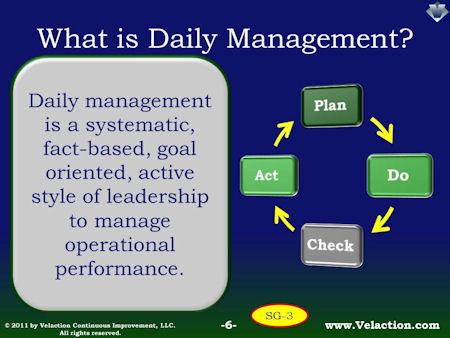
Daily management is a structured approach to running an operation. In a nutshell, daily management is the constant application of the PDCA cycle to a production process.
Daily management consists of:
- Planning: Daily management requires an understanding of what demand will be, and of the capabilities of the organization. It also requires knowing the schedule of your staff, and accounting for time away from production work.
- Doing: Daily management requires that leaders inform teams of the plan, and that teams know what the expectation They also need to know what to do when there is a problem.
- Checking: Teams and leaders must both monitor progress. With clear standards and an established pace, problems become obvious.
- Acting: Daily management requires taking immediate action to get back on track. It also requires countermeasures to develop permanent fixes when there is a recurring problem.
Click the image to get our Daily Management training module


Daily management provides a framework that allows an ongoing self-review of an organization. Its short-term function is to come up with an action plan to stay on track. This requires understanding the organization and demand enough to make a prediction about what the workload is, and how well the team can handle it. Obviously, if the numbers don’t add up, the leadership group must take action.
The long-term function of daily management is to enable more effective problem solving. It highlights abnormalities right at the time that the error occurred and ensures that the team addresses those issues before moving on.
Daily management requires ongoing scrutiny of the operation. For processes with a well-defined, consistent takt time, this might mean tracking each and every unit. For work areas with more variation, it might mean “bucketizing” the workload. That simply means that progress is checked every few hours. Most work tends to average out over time, so the noise within the system is accounted for, and the special causes pop out more.
The last activity required by daily management is doing something about problems. Because they are identified so quickly, the root cause tends to be easier to uncover than, for example, if you waited until the end of the month to look for the source of production problems.
Prerequisites for Daily Management
- The work area has defined processes. It is hard to review something if there is no standard to review it against.
- The area has established norms and goals. Most often, these are represented by Key Performance Indicators (KPIs)
- The area has recognizable conditions. You have to be able to identify deviations from the norm. This implies visual management. Imagine trying to cook without a thermometer in your oven, and no numbers on the knob, and no timer. That is how many organizations manage workload.
- The team can do something about problems. It must have trained people with the time to take on problem solving. It also has to have the commitment and the discipline to stick with the daily management process.
- There is a strong leadership presence in the area. Drive by leadership is ineffective. The team has to know daily management matters. They see that through leadership behaviors. The most important action they will observe is what the leader does when production falls off the predicted pace. Leaders cannot be stretched thin and still expect daily management to flourish.
A Day in the Life of Daily Management
A typical day in the life of a team using daily management is rather structured. The leadership team arrives before the production workers and updates the plan based on the previous day’s production, the actual backlog, projected demand, and staffing. The final factor (staffing) would include meetings, projects, vacations, and anything else that pulls people away from their desks.
When the team arrives, the frontline leaders conduct a quick stand-up meeting with them prior to starting production work. They review the production from the previous day and identify any problems that occurred that kept them from meeting the goal. Any new problems are logged in a highly visible location. Previous problems are reviewed, and status updates are given. Any late deliverables are addressed. Progress towards KPIs are updated, and any necessary actions are reviewed. Finally, the current day’s production goals are reviewed, adjustments are made, and the team goes to work.
The leadership team walks around the area (gemba walk) to check things out and see if there are any issues that need to be addressed. They then go to work on the problems and actions from the morning meeting.
During the day, the team updates the production board, noting any problems that caused variance from the plan. The leader is highly present in the area, and possibly even has his or her desk located with the team.
NOTE: Learn more about the 9 Steps to Developing a Daily Management System from our Gotta Go Lean Blog article.
What is Daily Management?
Daily management is a framework upon which many other skills fit together and interact. It acts to make each of these other skills more effective and makes leadership more goal oriented. The structure it provides keeps teams from having to reinvent the wheel every day. It lets them quickly come up with an assessment of where the team is, how they are doing, and what needs to happen to make the day a successful one. Without effective daily management, the definition of a successful day is extremely subjective. An employee may have accomplished a record amount of work and feel successful. A boss may still see a large backlog, though, and feel like the day came up short. Daily management provides clarity.
Responsibilities in Daily Management
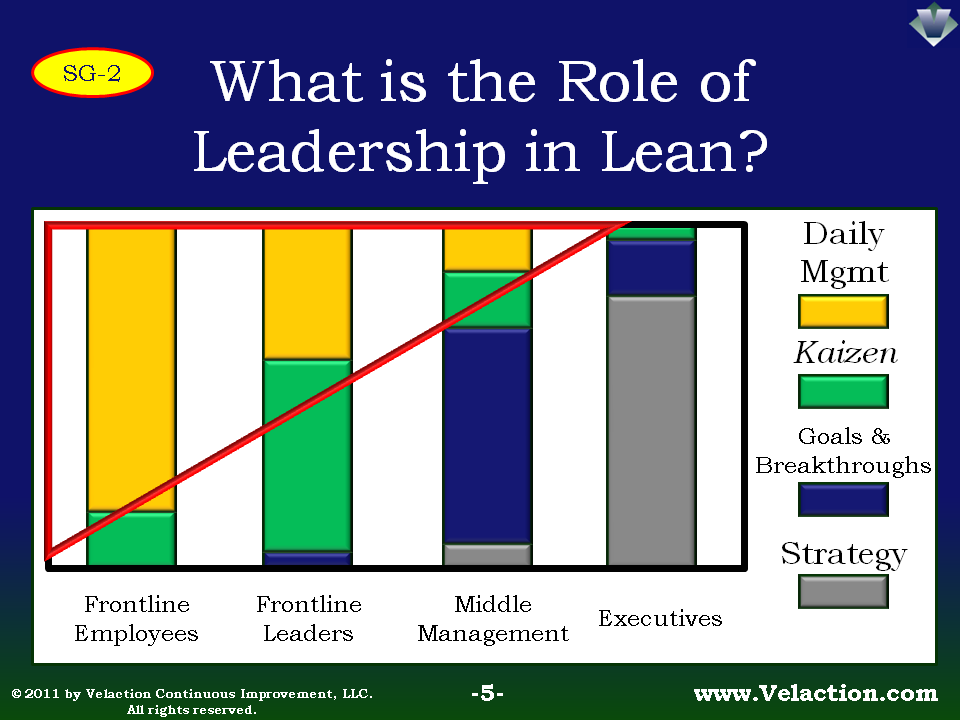
Daily management is intended to be run by frontline teams and leaders, freeing up middle managers to focus on big picture issues. Not only does this net the more senior leaders time, but it also creates a more autonomous workforce. Frontline employees learn more about the goals and objectives of the company. They are also able to make more decisions about their jobs, both in doing stopgaps to handle workload issues, and in eliminating problems.
Click the image to get our Daily Management training module
In addition to making the organization run more smoothly, daily management also does wonders for job satisfaction. It addresses some key factors that contribute to how much a person likes his or her job. Communication, trust, autonomy, opportunities, and fairness are all impacted by daily management.
Daily Management and Leadership
Daily management is not a substitute for leadership—quite the contrary. It forces leaders to address situations as they occur, and frees them up to be leaders, rather than detectives, trying to figure out what is going on. By standardizing routine aspects of leadership, daily management lets bosses work on important things rather than urgent ones.
The Challenge of Daily Management
Daily management is very difficult. First, it reduces the places to hide for both leaders and team members. Problems are placed front and center, as is the leader’s progress on guiding the team to a resolution. It becomes very clear when a team is not doing well. This can be embarrassing for some, and, in some cases can be dangerous. If a senior leader is not familiar with daily management, they may see the litany of problems that are inevitably uncovered as a bad thing, rather than a gold mine of process knowledge.
It is also a challenge because people are generally not used to being evaluated continuously in this manner. For many team members, it feels like micromanagement, and can become a point of contention. A politically incorrect truth, though, is that some people need micromanagement, at least until they develop a continuous improvement mindset. Sometimes, it takes up close and personal leadership to change a person’s direction and get them performing with the team.
If done without a purpose, though, micromanagement is a sign of poor leadership. The point of daily management is to eventually have the team members manage their own day to day operation. Good leaders have to train their teams to get to the point where he or she can let go of the reins. If people are clear on the goals, and have the proper skills, close-in management is unnecessary. Don’t confuse checking up on progress as micromanagement, though. It is a leader’s responsibility to know what is going on.
Playbooks / Battle Drills
Daily management starts with an assessment of both capacity and demand. That assessment is worthless if there is no way to adjust. Since most companies are already trying to maximize demand and seldom intentionally reduce it, the go-to method is adjusting capacity. That means adding and removing people from the team for short periods.
To do this, teams need to be cross-trained. Someone must have the skills to step in and out of a process quickly. Typically, this is covered with a battle drill or playbook. When a particular situation presents itself, the planning and preparation is already done. It just becomes a matter of announcing the decision rather than trying to figure out what to do.
Typical battle drills include:
- Calling someone from a resource team. Many continuous improvement focused companies have people who are available to help with projects or backfill when team members are doing kaizen.
- Managers, supervisors, and engineers doing production work.
- Swapping people with a partner team.
- Shutting down a support function to support customer-facing work. You likely see this in supermarkets when the manager calls for checkers if long lines are forming. Those people were probably restocking.
- Announcing overtime. This is a viable option as long as it is an exception rather than the norm.

Play a sample…

Daily Management Words of Warning:
- Don’t confuse daily management with micromanagement. Tracking progress is essential to identifying subtle, repetitive problems.
- Daily management without a focus on improvement is worthless. It just ends up consuming resources but doesn’t deliver any gains.
- Daily management is far more effective when paired with a flexible workforce. You have to be able to adjust staffing, both up and down, to meet demand. This doesn’t work if your team takes help but never offers it up.
- Some people are sensitive about posting their progress up on the wall. If this is you, get over it. Visible metrics are a part of continuous improvement. If problems are hidden, there is seldom much drive to solve them.

Daily management can be hard to get used to. It comes across as a way for managers to track their teams. The truth, though, is that daily management tends to be more well-received by solid performers than by people with poor work ethics.
Ultimately, daily management is a contract. It uses a standard for how long work should take and compares it to expectations. This usually ends up working in favor of the team. The “get it done” mentality, despite its positive press, is horrible for Lean organizations. It tends to mean that the process is not being followed, leading to quality issues. It also shows a lack of respect for people. It makes them cover for management shortcomings by working harder. With daily management, 8 hours of work should yield the same output regardless of the amount of work in the queue.
The key is that the management team should focus on the process when there is a gap between the expectation and reality. Solid team members, the ones who are trying to do a good job, are often hampered by process problems, system issues, shortages, and any number of other glitches. When this happens, daily management requires tracking the issues. If nothing is done to eliminate those issues, the problems pile up in a visual location, and the boss has to answer for it. In most cases, though, daily management uncovers problems that the boss would not otherwise know about. That lets her work to solve them.
So why don’t poor performers like daily management if it solves problems? One of their favorite tricks is to stretch work out when demand is low so they won’t be asked to do anything else. Daily management makes this visible, and the person has to account for the delay. Again, this is not intended to be punitive. It is to find where the process is broken. But if time and time again the person is unable to point to where the process failed, it becomes apparent that it is really a people problem.
When you take on daily management, you are in for a lot of upfront work to make the operation work much more smoothly down the road. Initially, you’ll have to assess demand. You’ll have to standardize your processes. You’ll have to train your team, post a daily management board, and figure out how you are going to manage it.

Exclusive Content for this Section is available at academy.Velaction.com

Key Points When Implementing Daily Management:
- Daily management balances actual capacity with projected demand to set clear expectations for a team.
- Daily management helps identify problems right when they occur, or soon after. That immediacy makes the root cause much easier to discover.
- Daily management will take substantial effort. Don’t get discouraged at the initial work. It will pay off once you get to the steady state.
- Make sure there are trained resources available to help with improvement efforts. If you don’t make improvement part of the job and staff for it, you won’t be successful.

Learn more about daily management with Daily Management Module.

Next Steps to Implement Daily Management:
- If possible, find a mentor to help you set up your daily management system. This may be a consultant, a new hire, or someone already within the company.
- Choose an area to be a pilot for your daily management system. The area should have a strong leader and a receptive team. Areas in crisis are a bad idea, as the extra stress can make the change hard to manage.
- Begin developing the pilot daily management program. Use our article, 9 Steps to Developing a Daily Management System, as a guide.
- Document and refine your daily management processes.
- Roll out daily management throughout your organization.

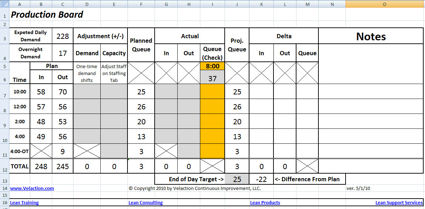
Use our Daily Management Worksheet to quickly calculate the data needed on your daily management board. It determines capacity based on available staff, and projects how much production work should be completed. It also tracks and highlights variance.

0 Comments