Checklists
Checklists are in rather common use and the general concept of their use is understood by most. But they are commonly misused and there are multiple potential pitfalls with this type of standardization tool.
Some checklists require the steps to be completed in a precise sequence; others, like a checklist for packing, just remind you of all the things you need. Some require checkmarks, readings from gauges, times, initials, or even signatures. Some are for reference only—no writing necessary.
Most people regularly use a stripped-down version of checklists in their daily lives: the “To Do” list.

Obviously, the “To Do” list keeps you from forgetting things. More importantly though, checklists help ensure consistent and safe results. You probably would head for the nearest emergency exit if you saw your pilot throw the pre-flight checklist in the trash before he entered the cockpit.

The New England Journal of Medicine studied the use of checklists during 7,688 surgical procedures. The checklists were nothing fancy. They were mostly just for preparation, like making sure there was enough blood on hand in case of an emergency, and that the patient’s identity was confirmed. The bottom line? Death rates dropped by nearly a half, and serious complications were cut by over a third. (Szalavitz 2009)
Think about that. Airline pilots and surgeons are both intelligent and highly trained experts. Yet, they still benefit from the use of a checklist. What do you think checklists will do for those of us who do not have life-or-death jobs or years of training? Will they keep us on our toes? Absolutely.
The Benefits of Checklists
- They provide a written record of the steps in a process.
- They standardize training, since everyone learns from the same document.
- They keep employees from forgetting the steps in a process.
- They help leaders confirm that things are done properly.
Suggested Checklist Applications
- To record a process.
Since checklists are relatively simple, they are a good first-pass method of recording company processes. Leaders can use this to get large numbers of methods recorded with minimal effort. Many employees have access to a computer and can type. The simple format of a checklist doesn’t take any special software skills to complete.
Often, frontline employees rely on memory and word of mouth to share process information. Getting that information written down provides consistency.
Documentation also protects the company from losing valuable expertise if the person ever moves to another position, or worse, leaves the organization.
Recording a process also has an additional benefit. It can lead to sharing best practices and helping team members build agreement about a procedure.
- To make sure that something was accomplished.
Checklists are reasonably effective, short-term methods for helping employees follow processes (especially in the absence of direct supervision). This reduces the conflicts between employees and bosses when things don’t go right—an unpleasant encounter for everyone involved.
In the long-term, though, the need for checklists should be eliminated through process improvement. While checklists can be very effective, they are also wasteful.
- When a trainee is first turned loose on his own.
Checklists help with that transition. Nobody likes that feeling of working without a net. Checklists are that safety net.
- To reduce quality issues.
When a quality issue is discovered on a product, checklists are good short-term stopgap. But don’t neglect permanent countermeasures, or you will be using that checklist forever.
- To support cross-training.
When employees are absent, it can be hard for someone to fill in. Checklists make it easier for a backup to do work they don’t normally do. Having an effective replacement, especially in the office, keeps employees from returning to a huge pile of work on their desks.
- To create a written record.
On occasion, there has to be some documentation that a task was completed in a specific way. Checklists with room for initials and dates are commonly used to do this.
- To compensate for fatigue or monotony.
Some jobs wear people out. Fatigue and boredom lead to errors. Checklists help by serving as reminders, so nothing is forgotten. It is much easier to remember to look at a checklist than it is to remember all the steps of a process. People tend to worry less when they have a tool to help them avoid mistakes.
- When performing a complicated, but seldom done process.
Weekly maintenance checks, annual budgets, or reinstalling a computer operating system are not done often enough to be committed to memory, but mistakes will cause big problems. Checklists serve to remind people how to do a task that they only do once in a while.
- When a process has several handoffs.
Checklists communicate what has been completed in a process. For example, a mortgage application may bounce between several people. At a glance, a checklist would communicate which specific steps, like credit checks, are complete and which ones still need to be done.
Some basic checklist guidelines include:
- Make them easy to understand.
One of the benefits of checklists is simplicity. Some of the more complicated standardization tools (standard work combination sheets, process flowcharts, etc.) require an understanding of the specific document in order to use it. Don’t negate the simplicity by making the checklists too long and inclusive or by using big words when simple ones will do. People are in a hurry. Eloquence is nice in a novel, but not when a takt time clock is counting down.
- Prove the process.
A checklist is only effective if the process itself is effective. Take the time to observe someone using the checklist in a real-world situation. Make sure the results of the process are what you really need.
- Match the detail to the need.
Preflight checklists help keep hundreds of people from plummeting to their deaths. Those lists should be extremely detailed. A checklist for making peanut butter and jelly sandwiches probably doesn’t need a whole lot of steps. Don’t overcomplicate things.
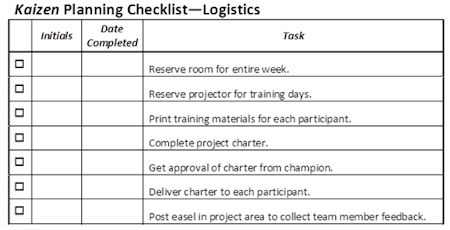
Sample Kaizen Checklist


Checklists can be very beneficial when used correctly, but make sure to keep the following points in mind:
- Is sequence important? In many cases, the wrong order will create poor quality or dangerous situations. For example, inspecting a propeller should be done before starting the plane’s engine. If you feel unsafe following a process, make sure to immediately change the checklist.
- How much detail is needed? Leaders should coach employees on how to make a checklist that has enough information to be useful, but not so much that the user gets bogged down in detail.
- Will the list get used? Actually recording values from the process—whether a fluid level, a voltage reading, or a time the task was accomplished—can help tie the checklist to the process and make it more likely that it will be used.
- Checklists can be effective tools but are not very robust. That simply means that they don’t guarantee that a process is followed the way something like workstation design or a poka yoke
- Are users just going through the motions? Watch out for pencil-whipping. That occurs when users simply scribble initials or checkmarks down the list after the process is complete. You can easily identify this by a few tells. A properly completed checklist, especially in a production environment bears battle scars. It is dirty and it is torn or folded or crumpled. Also look for unevenness in the checkmarks. They will not be in a perfect column when they are done separately.
You can prevent complacency like this by making the correct answers meander down the page so the desired answers don’t line up (i.e. don’t let all the answers be in the “Yes” column). That way people have to actually read each question to fill in the right response.
You can also change the checklist frequently, so people don’t get used to it. It slows them down, but that’s the point. Make them stop and check their work.
You can take this even further and have several checklists in active use. Shuffle up a stack and make each one a surprise. Use a template with cutouts to verify that the correct blocks were checked.
- Managers, take care of your frontline employees. Don’t put them in a position where they feel pressured to cut corners. Make sure that the time it takes to fill out a checklist is included in the Standard Work.
- Checklists may have legal implications. Consult qualified counsel to discuss your particular situation.
- Poor checklists yield poor results. If they are hard to use, they won’t be pulled out when they are needed. If they are inaccurate, they will produce poor quality products.
- Giving blanket instructions to everyone on a team to record their processes on checklists may be met with resistance. People will feel nervous that they are being asked to record what they do. Leaders should give clear reasons why there is a sudden push to get things documented.

A checklist is a crutch for a poor process. If you make your processes robust, you can avoid the need for a checklist. Since you are likely strapped for time, get your team involved in process improvement.
Checklists should be used to strengthen a process, not as the primary method of standardization. Unfortunately, leaders often use checklists with some unreasonable expectations. Managers, don’t expect perfection from your employees just because you put a checklist in place.
You also face some leadership challenges when you use checklists. First, don’t let checklists or other standardization tools become a substitute for your presence at gemba (the actual place where work is done). Second, if you don’t enforce their proper use, you are setting a standard of poor discipline that will seep over into other areas.

Exclusive Content for this Section is available at training.Velaction.com

Key Points to Using Checklists in Lean Operations
- Checklists, when properly used, can add consistency to a process. Consistency improves quality.
- Using checklists effectively is more complicated than it seems.
- Checklists should support leadership. Don’t let them replace a leader’s presence where the process is done.
- Always make sure to check about any legal implications that come with using checklists during production.

Checklists are often used to compensate for shortcomings in a process. Refine your team’s problem solving skills with our range of training products in our Problem Solving Training & Resources.

Using Checklists
- Identify 3 processes that could benefit from having a brief (5-10) item checklist.
- Explain to the team why checklist would help, and train them on creating a checklist.
- Create the checklists and start using them.
- Review whether the checklists improved the process.


2 Comments
JPOLO · September 17, 2012 at 6:57 am
I have found this material interesting, easy to read and concise.
Jeff Hajek · September 17, 2012 at 5:36 pm
JPOLO,
Thanks for the comment. We aim to please. We always appreciate hearing that the materials were useful.
We do like to ask a favor, though, in return when people find the material helpful. Please spread the word about our resources. Getting more people coming to visit helps us grow and lets us get more content up faster.
Thanks again,
Jeff
Comments are closed.