| 🔍 > Lean Terms Directory |
Assembly Lines
Henry Ford is generally considered to be the inventor of the assembly line. In reality, he should be credited with the transition of the assembly line into the modern version of it. Primitive versions had been around in England for about a century. Henry Ford’s primary improvement was focusing the whole operation on supporting the assembly line.
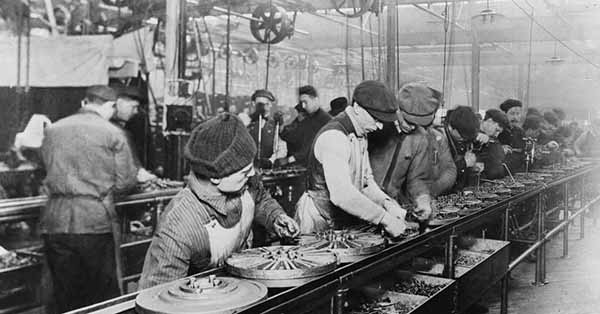

So, what is an assembly line? It is a series of operations, linked in physical space. Product flows from one end to the other, with each worker adding incremental value to the product as it progresses.
Some assembly lines are moved manually. At prescribed intervals, or once everyone is done working, they all move their work to the next station.
Lines may also be automated by a variety of means. The work might sit on a conveyor belt, be attached to a linkage in the floor that drags a carriage, or it might even hang from above.
Generally, line shifts are done at prescribed intervals. This is known as a pace/paced line, or sometimes as a pulse line or indexed line. Contrast this to a continuously moving line, where operators move with the product as it passes the materials and tools needed to build it.
Some lines run a single product down them. Others will build several different products, normally in a prescribed sequence. This is known as a mixed-model line. To keep the impact of the variation to a minimum, load-leveling, also known as heijunka, can be used.
Whole books can, and have, been written about this subject, so it is difficult to distill it down into just a few pages. There is an incredible amount of complexity contained in a well-functioning assembly line. When envisioning an assembly line, most people think about the relatively few, mega-lines. The images that come to mind are of the auto industry with thousands of workers rolling cars off in 60 second intervals (takt time). They think of aircraft manufacturers with swarms of workers bustling over a fuselage as it works its way down a cavernous hangar. Most assembly lines, however, are much smaller and less automated—maybe a score of workers building a refrigerator, or three workers assembling an electronic product.
Assembly lines are the bread-and-butter of Lean. It is the place where Standard Work is both most applicable, yields the biggest gains, and is easiest to understand.
0 Comments