Gotta Go Lean Blog

Podcast: The Lean Management Mindset, Part 2

Well, I have finally gotten around to editing the second part of my interview with Jay Watson about The Lean Management Mindset. If you are a regular reader/listener of the Gotta Go Lean Blog, you will recall that several weeks back, I posted part one, and mentioned that I’d post part two the following week. Well, time has passed, and now I am finally getting it here for your listening pleasure. Part 2 is a Read more…

The Secret Trick for Office Kaizen Success

Making improvements requires a complete understanding of a process. A surface knowledge leads to superficial solutions. Getting a permanent, robust, mistake-proofed process requires a level of scrutiny that takes a lot of time and effort. One way to simplify that deep dive and identify the underlying waste that impedes the smooth flow of information is to break each administrative process into its core activities. Let’s back up a little. In the early 1900’s, Frank and Read more…

June 2010 Newsletter: What’s New?

There’s some good news and bad news on the ‘What’s New?’ front this month. Great Growth! (The Good News) On the plus side, traffic has been climbing steadily. We grew at an annualized 13.4% monthly increase in traffic over the last year! It’s been great to see people from all over the world subscribing to this newsletter, signing up for our Gotta Go Lean blog, and registering on our site to get the helpful user-only Read more…

Therbligs

In the early 1900’s, Frank and Lillian Gilbreth refined a system of analyzing work to improve processes. They focused on identifying the core “motion cycles” that combined to form work activities. This detailed understanding of work let them identify inefficiencies and eliminate waste. The name “Therblig” comes from a near reversal of the letters of their name. The Therbligs are: Search Find Inspect Select Grasp Hold Pre-Position Position Use Assemble Disassemble Transport Loaded Transport Empty Read more…

Hoshin Kanri

Hoshin kanri is a Japanese term meaning policy deployment or strategic planning. Hoshin kanri has a few characteristics to it: Stretch goals: Hoshin kanri requires leaders to develop stretch goals that may take a number of years to achieve. These goals should come from business opportunities or risks on the horizon. Catchball: The planning sessions should not be done in a vacuum. Senior leaders should talk to each other and to their subordinates to create Read more…

Gembutsu

Gembutsu is a Japanese word meaning “real thing”. It is one of the components of the ‘Three Reals‘ meaning go to the real place (gemba) to see the real thing (gembutsu) and collect the real facts (genjitsu). This term simply means that there is no substitute for seeing something with one’s own eyes. Far too often, people hear about a process or problem, and take what they hear as fact. Watching an actual item being Read more…

Counterclockwise Flow

Many Lean experts advocate setting up work areas so there is counterclockwise flow. This principle goes hand-in hand with the U-shaped cell. Using a counterclockwise flow comes from the fact that most people are right-handed. As they move through the cell, their dominant hand is closer to the work sooner. While it seems on the surface that this might not save much time, the seconds add up quickly in a fast-paced work area. It also Read more…

Change Agent

A change agent is simply an advocate for change, who follows up on those convictions. He or she not only expresses a desire for change, but also attempts to rally those around them to join the cause. While change agents can be of any rank, they must have influence to make an impact on those around them. Change agents work best from within the company. Frequently, companies will hire a speaker, or a consultant to Read more…

Breakthrough Objectives

Breakthrough objectives are targets that can only be achieved with significant changes to the way the company operates. A company cannot achieve them by doing business as usual. Breakthrough objectives often cascade down from an aggressive strategic plan. Sometimes a breakthrough objective is established based on an opportunity. For example, a new vice-president with previous Lean experience may be set an aggressive goal to dramatically reduce finished goods inventory and do more make-to-order production. In Read more…

Blitz, Kaizen

A blitz is an intensive project, typically a week long, with focused gains in mind. The term kaizen or kaizen event are sometimes used interchangeably with blitz. Kaizen, in a broader sense though, is any effort to make something better. It makes for a bit of confusion about whether you are talking about a structured event or just a general improvement effort. The overall process for a blitz is something like this: Pre-Work Identify opportunity. Read more…

Kaizen Problem Statement on Charter Form

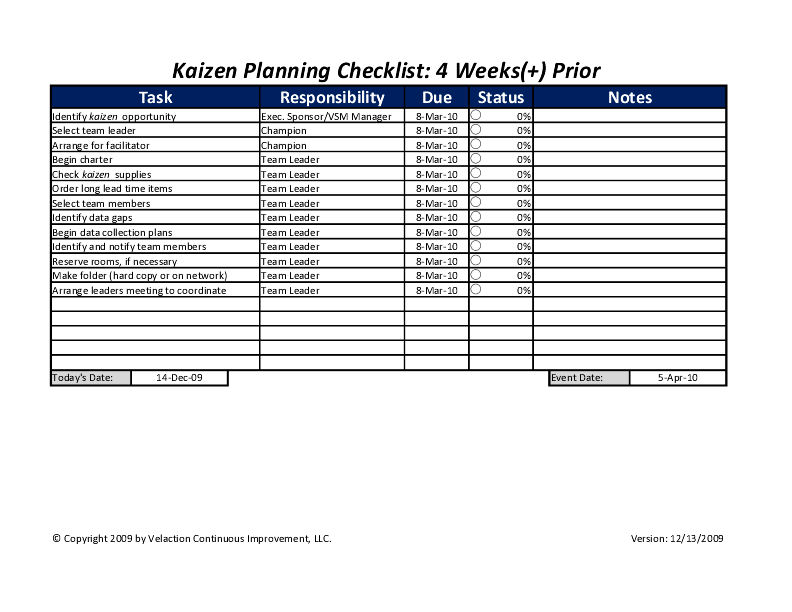
Kaizen Checklist

The kaizen checklist is a tool used to avoid mistakes when conducting a kaizen event (a.k.a. kaizen blitz, rapid improvement workshop, etc.) A good kaizen checklist covers the planning, the actual event, and the follow-up work. It assigns specific people to tasks and gives deadlines for each action. Get Our Kaizen Checklist Form for FREE This kaizen checklist consists of six pages. It has checklists for each of the four weeks prior to an event, Read more…

Anomaly

An anomaly is a condition outside of the expected range. Generally, an anomaly has an unusual or unexplained circumstance around it. An explainable spike in a pressure gauge is not an anomaly. Car tire pressure rising after driving isn’t an anomaly. An unexpected, temporary increase would be. If one tire was lower than the other three when you thought they should be the same, you would be seeing an anomaly. Anomalies tend to be fleeting, Read more…