Gotta Go Lean Blog

demings 14 points

14 Points, Deming’s

In his book, Out of the Crisis, W. Edwards Deming lists his 14 points for management. The overall aim of the book is to transform the style of American leadership. At the time the book was first published in 1982, American industry, especially automotive companies, had started to lag behind Japanese companies in terms of quality. Deming spent many years working with Japanese companies and came up with his 14 points as a way that Read more…

Last-In, First-Out

In accounting, last-in, first-out (LIFO) is a method of recording inventory. It is used to manage earnings in inflationary times. A last-in, first-out inventory system records the most recent price of materials as the cost, thereby making earnings reflect current prices. As a result, the older items, purchased earlier when prices were lower, remain on the books. This can have some impact on taxes as well, as the net inventory value is lower under LIFO. Read more…

Autonomy

Autonomy is the state of being competent and empowered to make decisions on one’s own. Self-directed or self-managed work teams are examples of autonomous groups. In the most effective application of these sorts of teams, workers own the process, rather than having supervisors or leads giving direction. This responsibility may include continuous improvement efforts, goal setting, maintenance, problem resolution, production tracking, and other daily management issues. As a company becomes Leaner, it requires greater levels Read more…

Mistake Proofing

Mistake proofing devices, also called poka yokes, are the most effective way to improve quality. In a nutshell, a product (or process) is designed in which a mistake is impossible to make. This problem prevention is targeted at specific errors. In order to mistake proof a process, one must have a thorough understanding of the ways the process can fail. Mistake proofing can be done proactively by considering likely quality problems, or it can be Read more…

Design of Experiments

A Design of Experiment (DOE) is the process of determine the interaction of KPIVs (Key Process Input Variables) on the output of a process. It attempts to quantify the relationship of the variables in order to optimize the settings for that process. A key point of the design of experiment process is that it changes several variables at once. That allows the statistics behind the process to identify interactions between the KPIVs. The design of Read more…

Agile Manufacturing

Agile manufacturing describes a company’s ability to be responsive to the marketplace. A company has to be able to roll out new products and services as the needs and desires of their customers change. It also has to offer increasingly varied product mixes and greater customization when customers require it. Agile manufacturing promotes the belief that these rapid adjustments can be done in a cost-effective manner. Agile manufacturing is rooted in the fact that your Read more…

Water Spider / Water Strider / Mizusumashi

A water spider or ”mizusumashi” in Japanese (see our listing of Japanese Lean terms), is a person who has a prescribed set of tasks to keep materials in stock at the point of use in production areas. NOTE: The water spider is alternately called a water strider. This differs from a material handler in that the sequence of operations and the way the tasks are performed are specified. A water spider’s purpose is to handle Read more…

Functional Layout

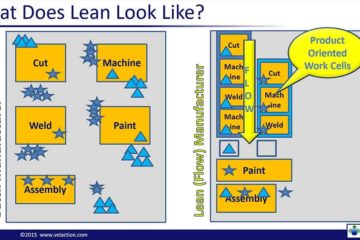
A functional layout is a workplace organization in which processes are organized by the type of work (function), rather than by value stream or in a cellular configuration where sequential process steps are located in close proximity. In a functional layout, for example, the cutting machines would be in one location, the press brakes would be in one group, the welders would all be together, and so on. The same is true in office environments. Read more…

It’s About Time!

Actually, this article really is about time. In Lean operations, there are many, many, many references to time. This is a comprehensive list of time terms you may run across in your continuous improvement travels. Please feel free to offer additional time terms in the comments section, and I’ll update the list. Automated (or Automatic) Machine Time (or Machine Cycle Time): The time that a machine is doing its work without an operator. There are Read more…