Gotta Go Lean Blog

Lean Litmus Test Question 1: Do small goals add up to big success?

I recently posted a list of questions that I use as a litmus test when I start working to help an organization improve. The first of these questions was: If frontline leaders hit all their individual targets, would the company hit its goals? I ask this question to get a feel for how the company manages its strategy, as well as to get a read on how accepting or resistant the senior leaders will be Read more…

Lean Newsletter Archive, January 2012

You’ve received this email because you signed up for our newsletter at www.Velaction.com. Get Free Lean Leadership and Problem Solving Classes When You Buy the DVD Packs     New (Free) Products: We’ve added to our Lessons of the Day curriculums, so there are even more ways to keep improving your continuous improvement skills. Lean Terms: We’ve added 13 new terms to our online guide since our last newsletter. What’s New?: We’ve posted several new videos Read more…

Lean Newsletter Archive, February 2012

You’ve received this email because you signed up for our newsletter at www.Velaction.com. Get a free Lean Trivia Game w/ our Complete PPT Bundle. Plus, learn how to get $500 in floor marking materials for free.     New Products: We’ve added a great new PowerPoint class that shows how a Lean Management System should work. Only $10.99! Special Offers: Buy our Complete PowerPoint Bundle (27 classes for $69), and get our Lean Trivia Game free. Read more…

The Lean Assessment Litmus Test

One of the jobs of a Lean consultant is to assess organizations to see where they are in their continuous improvement journey. There are many techniques to get a precise read on a company, but a thorough assessment can take a significant amount of time. Fortunately, there is also a quick litmus test you can use to tell if a company is serious about getting better and ‘gets it’, or if they are more interested Read more…

What Spammers and Scammers Can Teach You About Lean

Every morning, as I clean out the assortment of spam, scams, and general junk mail from my inbox, it strikes me that the senders seem to have a fairly strong understanding of Lean principles. Don’t mistake that comment for me saying that I approve in any way of what they do, or that they are in any way principled. I just mean that they are following some of the same concepts that I teach when Read more…

Names

Remembering someone’s name tells them that you place value on them as an individual. It shows that you respect them enough to remember who they are. Unfortunately, many, if not most, people have an extremely hard time remembering names of people they see only periodically. In leadership or continuous improvement roles, the burden of remembering names grows. If you are a frontline employee, you may need only to remember the names of a few co-workers, Read more…

Concrete Head

A concrete head is someone who is resistant to the changes that Lean brings. Obviously, this is a derogatory term. The term “concrete head’ is the result of a translation from Japanese. In working with Japanese consultants, it appeared that the term was applied to individuals who displayed resistance, but was used matter-of-factly. It did not seem to carry the same negative charge that it does in its English translation. In the US, the term Read more…

Asset

In accounting terms, an asset is an economic resource owned by a company or individual. Assets hold value because of the future benefit they can bring. An asset may fall into two categories—tangible and intangible. Tangible assets are what you would expect. Stuff you can touch—buildings, vehicles, machines, etc. Tangible assets are further broken down into noncurrent assets (the stuff mentioned already) and current assets, which typically include inventory, cash, and securities (i.e. stocks). Obviously, Read more…

6 Ways to Improve Problem Solving in Your Company

At its core, much of continuous improvement is about problem solving. Tools such as Standard Work, policy deployment, kanbans, and andons are all really just pre-packaged solutions to common problems. Despite that focus on resolving issues, few people have well-developed problem solving skills. This holds true even in companies that have been on their Lean journey for an extended period. The list below shows a ‘big picture’ view of problem solving, and ways to improve Read more…

Are You Kidding Me? You Call That a Metric?

I’ve been trying to improve my overall fitness. Fortunately, it just got easier for me. Pizza and fries are now officially healthy choices. Congress has confirmed that both count as vegetables in school lunches. I am going to increase my consumption of both, as we are supposed to load up our diets with produce, right? This falls squarely into the “Are You &**#@ Kidding Me?” category. Apparently, schools will soon be getting credit for providing Read more…

Standard Work-in-Process

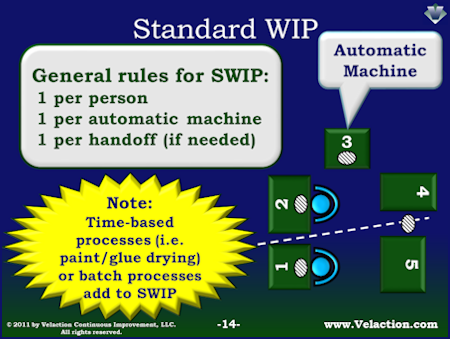
Standard work-in-process (or Standard WIP, or SWIP) is the designated minimum amount of material needed to keep your Standard Work flowing. It is one of the three main components of Standard Work. The other components include balancing the work to the takt time, and assigning it to a single operator. The consistent quantities designated by standard work-in-process help reduce variation and eliminate the accordion like effect that fluctuating work-in-process has on lead time. The purpose Read more…

Discontinued Product

We are sorry, but the product you are looking for is no longer available. When we change our product line, we make every attempt to remove all references to the discontinued product. Unfortunately, on occasion, one slips through the cracks. Please note that we will honor any current, active ads on www.velaction.com, or in an active version of a download that is still posted on the site. Please let us know where the ad is Read more…