Gotta Go Lean Blog

Acceptable Quality Level (AQL)

An acceptable quality level (AQL) is the percentage of defects allowed for a lot before it is rejected by a customer. Due to the size of most lots and the costs of 100% inspections, the quality of an incoming lot is frequently assessed with a sampling plan. The AQL will translate into a number of defects that are allowed in a sample of a specified size. AQL may be negotiated in a purchasing contract, or Read more…

Curiosity

Curiosity is the desire to learn more, or the state of dissatisfaction with a lack of knowledge. It is also a fundamental part of any problem solving mentality. Curiosity provides the drive to follow up on an issue once it is identified. It gives the spark that makes people continue to question what is going on even after the surface answer has been found. It also prevents accepting a “brush-off” answer to a question. Curiosity Read more…

Line Stop

A line stop is exactly what it sounds like. A team member presses a button that prevents an assembly line from advancing. This typically happens for one of two main reasons. Someone discovered a quality issue. Someone was not finished with their work. Other reasons might include maintenance problems, misplaced tools, or parts shortages. But in most cases, quality and exceeding the takt time are the biggest items that would show up as the largest Read more…

Where did the name “Velaction Continuous Improvement” come from?

Where did the name “Velaction Continuous Improvement” come from? There are two parts to this  answer. The first is the origin of the word “Velaction”. The company originally started out as Cascade Corporate Solutions due to our location in Seattle near the Cascade Mountains. Eventually, as we started to grow, we decided to find a less geographically limiting name. We soon realized, though, that the continuous improvement marketplace is crowded with consultants, trainers, bloggers, and Read more…

Takt Time Calculation

Takt Time

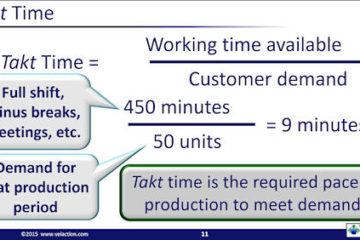
Takt time is the required pace of production to meet customer demand. It is calculated by dividing the working time available, generally for that shift, by the customer demand during that time period. Despite its apparent simplicity, it is one of the most misunderstood terms in continuous improvement. It is frequently confused with cycle time. The confusion stems from the fact that there are many nuances to determining working time. It can also be a Read more…

1/3 – 2/3 Planning Rule

The 1/3 – 2/3 rule of planning simply says that leaders should take a third of the time until a deadline to make a plan, and then provide their subordinates with the remaining time to develop their own plans and execute them. It is a simple rule of thumb that prevents senior leaders from monopolizing all the time available and pushing their teams into a crisis mode. This guideline is used in the military where Read more…

1/3 2/3 Planning Rule. Team Waiting

You just don’t believe what your boss tells you about Lean’s capabilities.

Most people have a baseline as far as what they think can be accomplished with continuous improvement. So, when a leader starts talking about Lean capabilities, many people take the message with a grain of salt. The gains that Lean offers can seem too good to be true, especially to someone in an organization that has been working hard but seeing little improvement.

Change Management

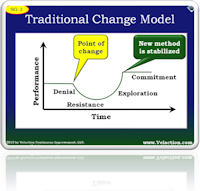
Change management is a fairly large field of study that deals with effectively and efficiently introducing changes into an organization. When changes occur, there are some predictable sequences of events that follow. Understanding this process will help smooth transitions that are associated with continuous improvement. Change has two main components. The first is the individual component. People have their own behavior, values, attitudes, and preferences. Most people have formed these over time and can be Read more…

CLOSED MITT

CLOSED MITT is an acronym used to categorize waste. It expands on the traditional 7 Wastes that are frequently used in Lean efforts. The origin of CLOSED MITT is unknown, but it has grown in use over the years. Since its early days, it has come into fairly common mention in a variety of publications and Lean websites. Watch a closely related video on the 7 Wastes. CLOSED MITT stands for the following types of Read more…

CLOSED MITT

Connections

All of you, our readers, share a passion for continuous improvement. But your similarity ends there. Each of you has different needs. Everyone learns in different ways. The demands you face in your businesses are unique. So, we offer a broad, customizable line of products and content to help you match your training solutions to the specific challenges you face. Like you, we are also trying to constantly improve Velaction. That means a steady flow Read more…

Communication

Communication is the act of transferring information and ideas from person to person. It comes in many forms. Face-to-face conversations. E-mails. Phone. Voicemail. Non-verbal communication (i.e. rolling of eyes). Pictures painted on the walls of caves. Even chalk marks on park benches can be a form of communication between covert agents. There are many, many forms of communication. Each one has benefits and drawbacks. Communication tends to rank highly as a factor that contributes to Read more…