Gotta Go Lean Blog

PDCA: Predict-Do-Check-Act?

Let me start out by saying that, contrary to the title, I am not really advocating changing the name of the PDCA cycle to “Predict-Do-Check-Act”. What I am really pushing for is that part of the planning cycle includes a prediction of what will happen when you make a change. If you recall back to high school, one of the steps of the scientific method is to form a hypothesis. And what is PDCA if Read more…

What is the origin of Lean?

What is the origin of Lean? Toyota is commonly credited with being the birthplace of modern Lean. One of the key proponents there, Taiichi Ohno, is commonly thought of as the father of modern Lean. While that is mostly true, there is more to the story. The Toyoda family owned the company that provided the fertile ground for Ohno to succeed in. Sakichi Toyoda was even the inventor of innovative looms that are the foundation of jidoka, or automation Read more…

Weekly Update (May 3, 2013)

Notable News

I had a glimmer of hope for common sense in the government this week. It turns out that a bill to get the FAA operating at pre-sequester levels had a typo in it. Apparently it was missing an ‘s’ to make ‘accounts’ plural, which would have limited funding. While this bill was needed in the first place due to an inability to effectively solve problems, it was a welcomed surprise that common sense dictated in this case. The actions the bill called for were taken before the bill had to weave its way back through the approval process.

Flow Chart

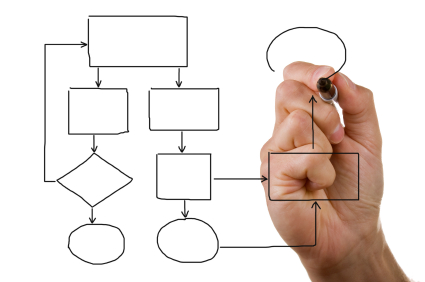
A flowchart is a visual representation of the progression of an entity (product, person, information, etc.) through a process. A flowchart is a visual representation of the progression of an entity (product, person, information, etc.) through a process. Flow charts have two main uses. Process flow charts are used for documenting the steps of an operation. The visual nature of the flow chart makes it useful for learning a process, for quickly checking the next Read more…

The Art of Saying “No”

It is a simple word. Just two little letters. Yet, it can be very challenging to say.

Why? Because we’ve trained each other to believe that saying ‘No’ is wrong. Say it to a peer, and you are not a team player. Say it to a boss and you are not willing to go the extra mile. Say it to your subordinate, and you might be thought of by any number of less than flattering names.

When is the best time to start a Lean journey?

When is the best time to start a Lean journey? There are three typical times that a company starts a Lean journey. The company is in a crisis and looks to Lean to bail it out of a mess. The company is doing well and comes across Lean as a way to continue its success. The company hires someone with Lean experience who helps it gain a foothold. Each of these situations has some pros and cons Read more…

You suspect you have started to get a bad reputation with your boss.

If you want to thrive in a Lean company, your boss must see you as being supportive of continuous improvement efforts. If she doesn’t see you that way, it is because of one of two reasons. Either you really aren’t supportive of Lean, and the assessment is accurate, or you are supportive of the improvement efforts, and your boss is off the mark about how you feel. Regardless of the reason, it is up to Read more…

Weekly Update (April 26, 2013)

Notable News

I just finished recording a new DVD: Managing with Metrics. It still needs to be processed and edited, but it is a step closer. It should be done this weekend or early next week. This isn’t just a product announcement, though. The notable part is that the development process reinforced my belief that learning and improvement never ends. This is my 19th DVD, and every time I go through the process, I find new ways to improve it. Even with all my experience developing processes, I still find new ways to make things better. Just goes to show …

Poll: What Are the Most Important Lean Leadership Traits?

POLL QUESTION: What Are the Most Important Lean Leadership Traits?

Leadership makes or breaks a Lean effort. Much of the gain comes from frontline effort, but that only happens when leaders set the right conditions for success.

This week’s question focuses on Lean leadership. We’d like to know what you see as the most important leadership traits for individuals guiding a team in a continuous improvement environment. This list comes from our 11 “C’s” of Lean Leadership.

New Data Collection Video: Understanding the Types of Data

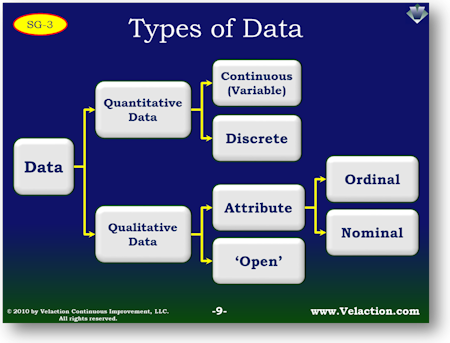
We just posted a new video on our YouTube channel. It comes from our Data Collection Recorded Webinar. Data collection is a core part of any problem solving effort. Choosing the right types of data to collect goes a long way towards getting this step correct. This short video takes about 5 1/2 minutes from our DVD and shows you the relationship between the 5 main types of data you will collect.

Data Collection

The data collection methods that you use lay the foundation for the eventual success of your continuous improvement projects. Simply put, data are the facts of the case. Raw data is then complied and processed into useful information that helps gain more insight into whatever you are trying to learn about. NOTE: Data is plural. Datum is the singular form. Data collection is the process of getting the data from the real world to some Read more…