Gotta Go Lean Blog

WIFM?

“WIFM” is a near-acronym for “What’s in it for me?” People tend to be rather logical, cause-and-effect types of creatures. They act when there is a reason to act. The basic premise of this acronym is that when that result of an action is in the best interest of a person, they are more likely to choose to do it. That’s not to say that people are inherently selfish. Rather, it just means that people Read more…
Warehouses

Warehouses are organized storage locations. They can store both finished goods or raw materials and components. While some warehousing can be unavoidable, in general, these types of storage facilities go against most Lean principles. Raw materials and components should be ordered just-in-time and stored at the point of use. If this is done properly, there is very little need to store vast quantities of materials in a separate location. The processes involved in storing these Read more…

Work Units

One of the basic goals of lean is to create flow. The rationale is that the more that material sits in one place, the more waste it creates. In most cases, this means a single piece of work moving through a connected process. This is where the term “one-piece flow” comes from. In some cases, though, it is okay for more than one item to move together. The most common situation is when there is Read more…

Relationships

A strong continuous improvement culture requires extensive teamwork, and teamwork requires strong relationships. First of all, let’s start by defining what a relationship is. And its surface, a relationship is simply the way people or organizations behave toward each other. But there is also a deeper layer to relationships. They also include how the involved parties feel about each other. How a person regards someone greatly impacts the way they act. Relationships are impacted by: Read more…

Schedules

Schedules are an important part of a continuous improvement culture. Daily schedules are used for communication and coordination as well as to highlight problems and improvement activity. For example, many teams start the day with scheduled time to get their work areas checked out and ready to go. They also likely schedule a standup meeting at the start of the day to resolve any issues that are uncovered and to communicate daily goals. Time to Read more…

Priority Matrix

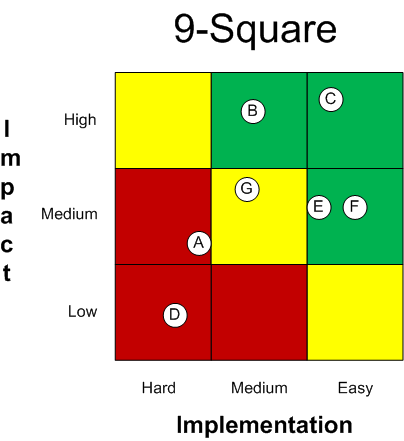
A priority matrix is a decision-making tool that helps, as the name implies, with prioritization. A common matrix will include the importance of an action (or problem) and the urgency of it. The goal is to work on the tasks that will deliver the biggest bang for the buck first. We have additional information on specific forms of priority matrix tools listed below. 9 Square Decision Matrix Template

Skills

The simple definition of a skill is the ability to do something well or having a particular expertise in an activity. In typical organizations, the set of skills required by individuals tends to be fairly narrow for frontline employees and leaders. For the most part, they are asked to do their job and not much else. When a continuous improvement culture develops, though, the requirements of every job become more demanding. Not only do employees Read more…

Helping Frontline Leaders

Frontline leaders are the people who make sure day-to-day tasks get done in an organization. They are leads and supervisors, and often have some production responsibilities in addition to their leadership role. They have an in-depth knowledge of the processes they supervise and a growing range of leadership skills. Add in their back office (spreadsheets, word processing, etc.) capabilities, and you have a group of people who are well-positioned to be key players in driving Read more…

Thank You For Your Purchase


Thanks for your order!

First of all, we wanted to let you know that we appreciate your business.

New Customers and Non-Members

If you have not purchased from us before, or have but are still not a member, we also want to let you know that you can get even more out of your training products by becoming a member at Velaction. You’ll get access to great member-only content on our website to enhance the products you bought, as well as some free gifts to help you learn more about our product line. In addition, you’ll also receive periodic updates about new content, notices about any special events such as webinars and member-only screenings of videos, and promotional offers.

Selecting the Program Leader

The program leader is the organization’s guide while creating a culture of continuous improvement. This person will work closely with senior management and will act their behalf when directing the organization on its journey.

This person is part project manager, part coach and mentor, part consultant, and part bulldozer. He or she is responsible for helping chart the course the organization will take, developing the skills the team will need to get there, and leading the organization down the chosen path.