| 🔍 > Lean Terms Directory |
Kaizen
Kaizen is a Japanese word that roughly translates to “change for the good”.
Many people equate this to putting together a team of people from several work areas to do a week-long project to reduce waste or improve a process’s flow. These projects may be called a kaizen blitz, a Lean event, a rapid improvement workshop (RIW), a rapid improvement project (RIP), or something else with a similar name. These all fall into the big bucket that covers the most common way people think of kaizen concepts
But kaizen means something more if you use the literal translation as a generic term to mean any improvement.
So, you might be asked to do some quick kaizen (used as a verb) to your process, which could mean just making a daily improvement, or it could mean being in a rapid improvement workshop. Kaizen is also used as a noun. “Joe, we need to do some more kaizen in the final assembly area if we are going to hit our targets.” Make sure you know how your company uses the term to prevent confusion.
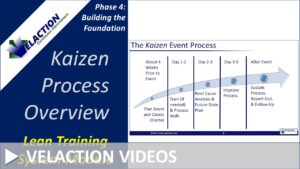
The first use of the term (as a week-long event) is the more common one in efforts to reduce waste. Kaizen events consist of a small team going after improvements on a specific process or in a single work area. These projects are structured and follow a well-defined kaizen process. The week-long period is long enough to allow the overhaul of an area with dramatic results, but short enough to be able to actually get people to participate. These projects are done both on the shop floor and in the Lean office.
At the beginning of the week, the team usually receives training just-in-time. Getting the training right when it is needed keeps people from forgetting what they learned. Kaizen training is generally between half a day and a full day; the team then spends a day or so going over the area with a fine-toothed comb to come up with a plan.
At the end of the project, the team follows up the project with a kaizen report out. This presentation allows the team to communicate the changes it made to those employees that were not involved in the kaizen, but who will be affected by its outcome. It’s also a chance to celebrate the success of the kaizen in front of the company’s leadership.
That leaves about two full days to actually make improvements. Often, the full days are really full. It is not uncommon to see kaizen teams working late into the night.
The second, more liberal, use of the term “kaizen” is far less structured. Pretty much any action you take to make an improvement is “kaizen”. I like this version of the term because it puts the power to change in the hands of everyone in the organization.
If improvement can only be made as the result of a somewhat bureaucratic process, people will just sit on problems. If they can take action, and are actually encouraged to do so, things get better much more quickly.


Kaizen teams should always try to keep their follow-up lists to a minimum. This is especially true on the shop floor. Teams often shut down production for a time while making changes. A long list means that getting things back up and running will be delayed, or that the operation will be hobbling along until all the follow-up action items are complete.
Lean office kaizens will often have bigger lists than shop floor (gemba) kaizens, since it frequently takes longer to make changes in administrative areas-especially when software is involved. Information technology has trouble making changes to computer programs overnight. Lean office kaizens also tend to impact customers more directly than shop floor events. Notifying customers of changes can delay implementation.
The use of kaizen is spreading. What started out as primarily a shop floor tool has spread, as mentioned above, to the Lean office. You will also hear about restaurant kaizen, service kaizen, and even retail kaizen. Education kaizen, military kaizen, and government kaizen are also on the rise.
In great companies, kaizen is not an isolated event. Instead, it becomes a continuous improvement culture where frontline Lean employees identify waste and make immediate process improvements.
Forms of Kaizen
- A week-long kaizen event.
Also known as kaizen blitz, rapid improvement process, or continuous improvement workshop. This is what people traditionally think of when they hear the term kaizen. These events use a lot of resources and tend to yield big gains.
- Daily improvement kaizen.
This form of kaizen is the “do it now” approach to using kaizen to make improvements. These are the “quick fix” tasks that usually don’t take very long to complete.
They are a critical part of a continuous improvement culture.
These small incremental gains, especially if they are made on an ongoing basis by frontline employees and managers, are effective tools that add to the bottom line.
- Kaizen projects.
This form of kaizen uses traditional project management to keep process improvement efforts moving forward.
Regardless of which form of kaizen you use, it can be thought of as the transmission of Lean. The tools and system provide the power—the engine, but kaizen takes that potential and transfers it into actual gains at gemba—the place where the real work happens.
Kaizen, PDCA, and Waste
Kaizen makes use of the Deming PDCA cycle (Plan-Do-Check-Act) to improve processes.
A large part kaizen gains come from observing a process and identifying waste (Plan).

0 Comments