With Lean tracing its roots back to Japan, it is not surprising that it is chock full of Japanese Lean Terms.
This Japanese Lean Dictionary gathers up all the terms Japanese terms in one place for your convenience.
An andon light is one of the basic tools of Lean and is one of the most common forms of visual management that you will hear about in Lean. In Lean, andon refers to a signal used to call for help when an abnormal condition is recognized, or that some...
Baka yoke is the Japanese term for 'foolproofing' or 'idiot proofing'. Needless to say, it is not the most politically correct of terms, and has been replaced in common use by poka yoke, or 'mistake proofing.' The principle is the same for both term...
A chaku-chaku line has a series of machines, each equipped with a hanedashi device, or autoejector. This enables the operator working a chaku-chaku line to walk up and immediately insert the part he is holding into a machine press a start button, a...
A concrete head is someone who is resistant to the changes that Lean brings. Obviously this is a derogatory term. The term "concrete head' is the result of a translation from Japanese.
Gemba has several different meanings, so to start let's use the literal Japanese translation and define gemba as meaning 'the real place'. In traditional (i.e. manufacturing) Lean, gemba is frequently used synonymously with 'shop floor.' (You may hear...
Gembutsu is a Japanese word meaning 'real thing'. It is one of the components of the 'Three Reals' meaning go to the real place (gemba) to see the real thing (gembutsu) and collect the real facts (genjitsu). This term simply means that there is no s...
A hanedashi device is an automatic part ejector. It reduces waste when an operator approaches a machine to load the next part. In a machine without a hanedashi device, the operator would have to set down the new part that he would be carrying to the ma...
The common heijunka definition, production leveling, means transforming the typical peaks and valleys of customer demand into something flatter. That flatness, in turn, makes standardizing production processes easier.
Heijunka is the Japanese term for level-loading. Heijunka is intended to flatten out the peaks and valleys in demand to create conditions that make standardization easier. It also stabilizes the product mix to support Standard Work. Heijunka is a work...
Hoshin kanri is a Japanese term meaning policy deployment or strategic planning.
The most common Jidoka definition is 'autonomation.' (The word is one of many Japanese terms that are common in Lean.) Lean Jidoka traces its roots back to the early 1900's at Toyota in Japan-then a textile manufacturing company. Sakichi Toyoda develop...
Kaikaku is revolutionary change. Where kaizen is generally evolutionary in nature, kaikaku requires radical shifts in thinking. Revolutionary changes tend to be far more challenging in nature and much less common than incremental improvement. Becaus...
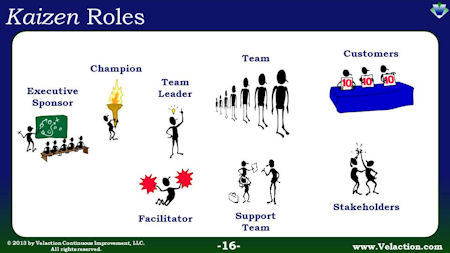
What is the meaning of kaizen? No translation is perfect, but kaizen is a Japanese word that roughly translates to 'change for the good'. Learning how to implement kaizen concepts properly goes a long way towards improving your job satisfaction in a L...
Kaizen is a Japanese word that loosely translates to 'change for the good.' So, kaizen simply means to make improvements to a process. Forms of kaizen A week-long kaizen event. Also known as kaizen blitz, rapid improvement process, or continuou...
A kaizen charter is a form that lays out the scope and goals of a rapid improvement project. [caption id="attachment_6490" align="aligncenter" width="334" caption="The Kaizen Charter Form"][/caption] The kaizen charter is a living document that evolv...
Kanban is a system used to manage the flow of inventory in a Lean manufacturing process. The word 'kanban', in Japanese, means 'signboard.' Kanban regulates inventory and helps promote flow. The most common kanban system uses two bins (or marked inven...
Download our 9-page Lean PDF on kanban to add to your Continuous Improvement Companion.
Many Lean terms originate from Japan. Muda is one of those terms. It really translates to ‘wasteful activity’, but in common practice most people simply use this definition: muda = waste. Since one of Lean’s main goals is reducing waste to impro...
Mura is one of three Japanese terms meaning waste. The others are muda, the traditional form of waste in which resources are not effectively used, and muri, meaning overburden or overexertion. Mura means inconsistency or excess variation in either pro...
Muri is a Japanese term for a specific form of waste. It means unreasonableness or overexertion. It is often referred to with two other Japanese terms, muda (the traditional view of waste in which resources are used without adding to output) and mura (...
Nagara is a Japanese term meaning 'while doing something'. It simply means to do more than one thing at a time. For example, a two parts may be fitted together as they are clamped into a welding fixture. Or, a person may be able to assemble two parts w...
A good poka yoke definition is simply 'mistake proofing'. Of note, the term poka yoke is of Japanese origin and is one of the handful of the more commonly used Japanese terms that have become mainstream in Lean circles. Poka yokes keep processes from ...
A water spider or 'mizusumashi' in Japanese (see our listing of Japanese Lean terms), is a person who has a prescribed set of tasks to keep materials in stock at the point of use in production areas. (Note that the water spider is alternately called a ...