It’s About Time!
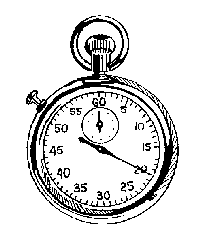 Actually, this article really is about time.
In Lean operations, there are many, many, many references to time. This is a comprehensive list of time terms you may run across in your continuous improvement travels.
Please feel free to offer additional time terms in the comments section, and I’ll update the list.
- Automated (or Automatic) Machine Time (or Machine Cycle Time): The time that a machine is doing its work without an operator. There are many variations on how this term is named.
- Buffer Time: This may be an official or unofficial time. In project management, it may be listed as a task buffer, a project buffer, or might be buried in the estimates without any specific mention. In processes, specifically with regards to Standard Work, you will seldom see something listed as ‘buffer time’. It would generally only formally exist as the difference between the official cycle time and the takt time. In practice, buffers often get buried in task times when there is a lot of variation, and thus are unofficial.
- Automatic Time: Synonymous with Automatic Machine Time
- Changeover Time: The time to go from the last good part of one type of product to the first good part of the next type.
- Cycle Time: The time it actually takes to complete one unit of work. Many subtle issues (machine time, waiting time, etc.) can make this term confusing. Often incorrectly used interchangeably with takt time. Determined with a stopwatch. Can be misleading for batch machines, as it doesn’t take setup time into account.
- External Setup Time: Setup time that is done while a machine is running.
- Idle Time: The time when a process or machine is stopped, generally for a lack of demand. Often confused with waiting time.
- Internal Setup Time: Setup time done when a machine is shut down.
- Lead Time: The time it takes for a product or office work to move between two points. Most commonly looked at in terms of the customer, from the time they place an order until it is received. Start and end points must be defined.
- Machine Cycle Time: The time a machine takes to do its work. May require an operator (i.e. a drillpress) or can be automatic.
- Machine Time: Synonymous with machine cycle time.
- Non Value-Added Time: Time spent doing a process that does not directly add value to a customer.
- Operator Cycle Time: Manual time an operator spends to complete one unit of work (i.e. one single product)
- Processing Time: The portion of operator cycle time actually spent working. (i.e. waiting time is removed)
- Queuing Time: Time a product spends sitting in line waiting to be worked on.
- Setup Time: The portion of changeover when a machine is being reconfigured for a new product.
- Takt Time: A calculated value that represents how often a customer needs a product or service delivered. Determined by dividing time available by demand during that period. Confusing to determine with multiple, unevenly staffed shifts.
- Throughput Time: Similar to lead time, but ignores the time spent in a queue before entering a process.
- Touch Time: Synonymous with processing time.
- Value-Added Time: Time spent doing something that adds value that a customer would be willing to pay for.
- Waiting Time: Time spent waiting for something to happen. Most commonly waiting for a part delivery or for a machine to finish a cycle.
- Walking Time: Time spent walking. Shown on a standard work combination sheet.




1 Comment
Il meglio della blogosfera lean #58 — Encob Blog · October 15, 2010 at 11:39 pm
[…] consigli su come rendere uniforme il messaggio del personale delle vendite (traduzione automatica)It’s About Time! dal blog Gotta Go Lean di Jeff Hajek: Tutti i vari modi di usare il tempo nel lean […]
Comments are closed.