Poka Yoke
A good definition of poka yoke is simply “mistake proofing”. Of note, the term is of Japanese origin and is one of the handful of the more commonly used Japanese terms that have become mainstream in Lean circles.
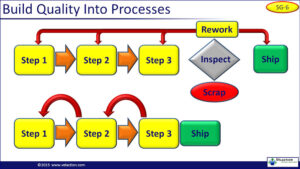
Poka yokes keep processes from producing errors. Preventing errors obviously improves quality, but it also plays a major role in improving productivity. With no rework, and easier production, cycle times and lead times both become much shorter. And, of course, faster production with fewer defects means lower costs.
While the term poka yoke originated on the shop floor, it is equally relevant in office, healthcare, and service settings.
Another similar term, baka yoke, meaning “fool proofing”, has fallen into minimal use, likely for reasons of political correctness. As an aside, the term is also frequently used as a verb, as in “John, can you please poka yoke that fixture?”
Of note, the last ‘e’ in the term is often pronounced as a long ‘a’. The pronunciation is poe-kuh yo-kay.
Mistake-proofing poka yoke devices surround people, preventing costly problems in their everyday lives.
Examples of Real-World Poka Yokes
- Car keys are one of the most widely used poka yoke They can be inserted with either side up. Of course, now, the mistake proofing goes even further and there is generally not even an ignition slot for the key (and probably only a hidden slot to unlock the door).
- Overflow drains on a sink (the holes high up on the side) are examples of mistake proofing devices that prevent making a mess when filling the basin up with water.
- Most computer manufacturers poka yoke their cables so the plugs only fit in one way. This prevents damage to the system.
- Printers stop printing when the paper is out. This keeps them from spreading ink all over the internal mechanisms of the machine.
- Sensors in gas nozzles knows when your tank is full. They prevent dangerous messes by shutting off the pump.
- Your ice maker in your freezer shuts off when the bucket is full.
- Your washing machine ends the spin cycle when it load gets out of balance.
The list is by no means exhaustive. With the loose ‘mistake proofing’ definition, poka yoke devices are everywhere.
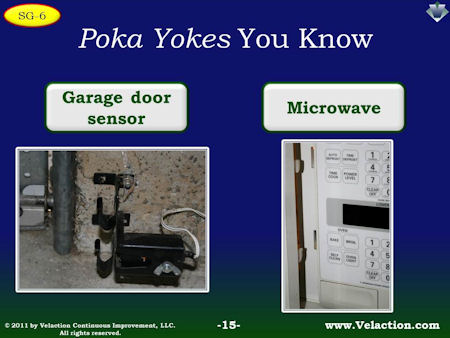
Poka yokes you already know.


A poka yoke device must make it physically impossible to make a mistake. While a poka yoke is often a physical device, such as a fixture that only accepts parts one way, processes and parts can also be designed to have a built-in poka yoke.
Some Poka Yoke Examples:
- Poka Yoke in Parts Design (primarily in manufacturing)
- Hydraulic hoses and wiring harnesses can have different size connectors. Hoses and wires can also be cut to lengths that make it impossible to install incorrectly.
- Parts can be either reversible (no incorrect orientation) or keyed to make sure they will always be installed properly.
- Poka Yoke Fixture (Physical Device) Designs
- Machines can have stops to prevent the wrong raw materials or components from being installed (fixture design).
- Racks can have limited space to carry only the proper number of parts.
- A scale can be added to a packing station. If the weight is outside of the proper range, software prevents labels from printing.
- Electric eye sensors can be installed in front of parts bins. The operator must trip them in the proper sequence and quantity prior to a line shifting.
- A computer program can prevent entering an order if the zip code does not match the city.
- Poka Yoke Process Design
- Two parts that are commonly mixed up can be moved to separate workstations to prevent errors.
- The sequence of installation can be changed to prevent one part from damaging another. This commonly happens when large heavy parts are installed over fragile parts, or when tools must be used in tight spaces.
Safety switches are similar to poka yokes. The little switch that keeps the microwave from running when the door is opened is a safety device that keeps you from zapping yourself if you try to get your food before the “ding”. The same is true of dual hand switches on heavy machines that must both be pressed for the machine to run. They are great—they keep your hands attached to your body. Just keep in mind that as important as these safety devices are, they don’t protect the output of the process. Poka yokes will protect you and deliver uncompromising quality.
Poka yokes can take some precision to fabricate. Identify a person that can become an expert on building mistake-proofing devices. Many manufacturing companies have a tooling group that is a source of great candidates. Just be careful that they don’t over-engineer solutions. Simple is better.
Most of these examples come from the shop floor where poka yoke has its roots. Because office processes tend to be more focused on people and software than on parts and machines, there tends to be fewer opportunities for mistake-proofing by frontline employees. Despite this, it is still very important in the office.
Computers and software are full of poka yokes. Field filters might ensure that the proper number of digits are entered for a phone number. A poka yoke in a call center may sign a person out of if his phone rings more than 4 times without an answer. This keeps the customer from waiting. Restricting functionality based on user type (administrator vs. user) is another example.
Benefits of Poka Yokes
Become familiar with poka yokes. They contribute to your success in two important ways.
The first benefit of poka yokes is obvious. They improve quality. If there is no way to make a mistake, defects can’t slip through.
Secondly, they improve cycle times which clearly benefits standard work and improves productivity. After all, when a process is mistake-proofed, it gets far quicker.
The gas pump example illustrates the point. How much longer would it take to fill a tank if you had to determine how much gas you had to start, and subtract that from the capacity of your tank, and then slow down the pump when you got close to being full? Plus, the auto-stop feature on gas pumps also prevents many overflows, reducing the amount of time spent on cleanup.
The zip code poka yoke example reduces rework for the customer service group. They have fewer lost orders to take care of.
Mistake proofing also speeds up processes in another way. It eliminates the need for inspections, since there is no way for bad parts to slip through.


Poka Yoke Warnings
- Don’t confuse a gauge with a poka yoke. A gauge identifies a problem, but an operator must remember to use it. Measuring devices, such as a ruler taped besides a cable cutting device, can make it easier to cut the right length of cable. But since they don’t prevent problems, they are not poka yokes.
- Don’t forget to review your poka yokes from time to time. Despite the definition of poka yoke as “mistake proofing”, no device is permanent. When processes or products change over time, poka yokes can become less effective.

Poka yokes are among the most beneficial Lean concepts for frontline workers. They keep you from making mistakes, but more importantly, they take the worry about making mistakes away from you. With less concern about problems, you can direct your energy in a more positive direction. Jobs where you are constantly concerned about missing production targets or scrambling to change plans when you have to stay late to do rework are never any fun.
Develop a talent for identifying opportunities for mistake-proofing devices. They will prevent you from making errors that can be a major source of frustration and conflict with your co-workers. Processes where you must pay close attention to avoid mistakes are a good place to start looking.
If you recognize places where a device can help, even if you don’t have a fully developed idea, present it to your coworkers, your boss, or an engineer that supports you. They will be able to add to your thoughts and will probably help you come up with a good solution to improve your quality.

Poka Yoke Information for Leaders
- If you are training your team about poka yokes, search your company for any existing devices in use. Then physically show the examples to your student and let them talk to the operator. Seeing the concept in use by a coworker really makes the lesson sink in.
- Poka yokes are also good relationship building devices. One source of friction between leaders and teams is when bosses have to make corrections on employees. Eliminate the source of mistakes, and you eliminate the hard conversations.
- Poka yoke devices are a great way to show respect for people. They make work easier, and let people focus on coming up with better ways to do their jobs rather than spending their energy trying to avoid mistakes.
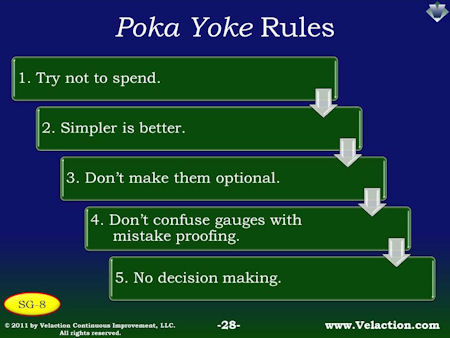
Poka Yoke Rules
When setting up poka yoke devices, follow a few basic rules.
- Try not to spend.
- Simple is better.
- Don’t make them optional.
- Don’t confuse gauges with mistake proofing.
- No decision making.

Poka Yoke Key Points to Remember
- The definition of poka yoke is simply “mistake-proofing”.
- Poka yokes are equally important in the office and on the shop floor.
- Becoming good at making poka yokes takes practice. The more you create, the easier they are to develop.

Make sure your team is trained on quality and poka yokes. What seems intuitive to some is not to others. Don’t assume everyone has the same perception about quality.
Find a persistent quality problem to address and try to resolve it with a poka yoke. This will be easiest in an area with standard work, as the process the poka yoke supports will not vary.


8 Comments
Gayathri · April 5, 2021 at 6:30 pm
Very good and clarity on poka- Yoke.
Excellent PPT
Jeff Hajek · April 10, 2021 at 9:19 am
Thanks for the compliment. Much appreciated.
viethai · April 5, 2010 at 2:04 am
I want a book which say that Pokayoke, but I don’t find it on internet. Can you provice it to me. If you can
Jeff Hajek · April 5, 2010 at 5:40 am
Viethai,
I have a few listed on my Lean store here:
https://academy.velaction.com/course/poka-yoke-mistake-proofing-trainer-download-pack
You can also search the Lean Store for poka yoke or mistake proofing to find more.
Good luck,
Jeff
U.S.RATHEESH · February 27, 2010 at 9:16 am
Poka Yoke is very good. But how we can apply this in Purchase Dept ?
Jeff Hajek · February 27, 2010 at 9:51 am
U.S.RATHEESH,
I would start by looking at the errors you face regularly and then look at the process step where the error occurs. If you can’t easily identify the step, it is an indicator that the process needs to be stabilized first. It is hard to poka yoke a process that isn’t standardized.
Once you identify the step, it is easier to see what you need to do to implement a poka yoke. In office environments, you’ll see a few common types of mistake proofing. First, you’ll see data entry/workflow error-proofing. Drop-down menus for vendors, for example, can prevent misspelling names, or creating multiple accounts (i.e. Acme and Acme Corp.) Workflow poka yoke prevents going to the next step if data isn’t complete.
Again, the errors you face will drive the poka yoke solutions. If files are frequently lost, a paperless system might be your poka yoke. If calls are missed often when someone is away from their desk, automatic call forwarding to a backup person might be the answer.
In summary:
1. Identify and track the defects you face.
2. Use the Pareto Principle to decide what to work on first.
3. Find the process step where the error that caused the defect occured.
4. If the process is not standardized, do that first or you’ll be wasting your time with the poka yoke. They are generally designed to match a specific process.
5. Think what would have to be done to prevent that error from ever occuring. This step takes practice to get good at it.
By the way–I’ve got a poka yoke training package that I’ll be adding to my store soon. It goes through this process in more detail.
Best of luck,
Jeff Hajek
U.S.RATHEESH · March 5, 2010 at 5:44 am
Very Good article on Poka Yoke for Purchase Department…
John S. Cyrus · February 1, 2010 at 8:09 am
Mistake Proofing concept has been explained in a simple and clear way. Very good article.
Regards,
John Cyrus
Comments are closed.