| 🔍 > Lean Terms Directory |
Better, Not Perfect
Better, not perfect is a mantra about conserving resources. It does not mean to stop seeking perfection. It just means that for now, don’t seek perfection in one area while others are still struggling. Generally, improvement costs rise as low hanging fruit is picked. That means that perfection is elusive. It will be harder and harder to make progress as you get better. Focusing your limited resources where they will get the highest return will speed the company forward on its Lean journey.


Improvement stalls when people shoot for perfection. Trying to take a project from pretty good to perfect wastes a lot of your time and energy—both of which are probably in short supply. It also likely takes you away from other problems that needs your attention. In most cases, the hours or days you could spend taking your current assignment from good enough to great don’t pay off as well as if you had used them on another pressing project—one that needs to go from poor to good enough.
At home you probably practice this philosophy as well. Imagine you are painting your kitchen. Chances are, if you put in a reasonable effort you end up doing a pretty good job. After you finish painting, if you were to do a final inspection and take a really close look at those walls (especially the brightly colored ones) you would notice tiny areas that were missed. You would probably also see small blotches of paint on an adjacent wall where it leaked through the masking tape.
So, you have a choice when you are done painting. You can say that the paint coverage meets your expectations and that the kitchen now looks much better than it did before. Or, you can spend your time on the detail work. Working on the minutiae can easily turn a six-hour painting job into a twelve, or even twenty-hour job.
Your weekends are precious, and you probably have better things to do on a Saturday than spend it with a magnifying glass, a jar of paint, and a fine point artist’s paintbrush. Your choice all depends on whether you value the results of a different project, more than perfectly painted walls.
The decision you make is really at the heart of “better, not perfect”. It is about a concept called opportunity cost. That simply means that the resources—time, money, space, etc.—that you use for this project could also be used for something else.
By all means, if you have unlimited resources, shoot for perfection. Most people, though live in a world where demands outpace their ability to meet them. The point is that everyone has to manage their resources. Every decision has a cost to it. Spend those resources where they will result in the most progress.

Play a sample…

Words of Warning for “Better, Not Perfect”
- Don’t confuse “better, not perfect” with slacking off. You are not settling for better in order to be done with a project. You are wrapping things up when you get a workable solution that frees you up to start on the next issue. Make sure you still deliver quality solutions. Just don’t get caught up in details that don’t pay off. Law of Diminishing Returns
- Watch out for diminishing returns. This is where it starts to take more and more effort to get increasingly smaller gains. Think about picking apples. Initially, they are fairly easy to get. The low ones are within reach, and the ripe ones are plentiful. But as you pick, you will find yourself having to climb higher and higher into the tree. The pace of your picking drops off sharply. Eventually, you will slow to a trickle. There might be a few good apples left, but the time it would take to find and harvest them would be excessive. As you get closer and closer to perfection, you face the same problem. It gets harder to make gains.
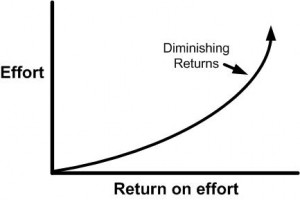
Law of Diminishing Returns
- Make sure projects meet their goals. “Better, not perfect” doesn’t mean cutting corners. Rather, it means avoiding the extras when there are other, more pressing projects that need attention first.
- Perfection is a myth. There is always some way to improve a process, so it will never be perfect. And the closer you get to the ideal of perfection, the more effort it takes to make tiny, incremental improvements.
- Don’t focus on how things look unless that is important. Prototype tools and fixtures might end up working well but look ugly. Make sure appearance matters before you spend time rebuilding.

Exclusive Content for this Section is available at academy.Velaction.com

Exclusive Content for this Section is available at academy.Velaction.com

Key Points About “Better, Not Perfect”
- “Good enough” is not bad. It means “meets the standard”.
- Everything you do takes away from something else. Is the extra benefit worth that cost?
- Leaders and employees must be on the same page regarding when a project is better.
0 Comments